Smart warehouse: The future of intelligent logistics
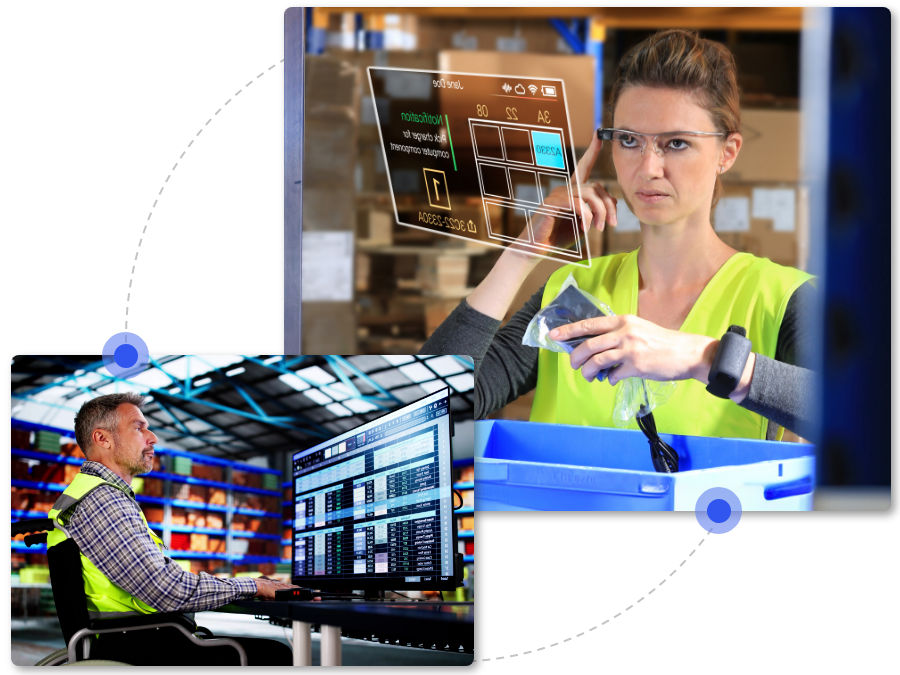

Definition: A smart warehouse is a digitally connected logistics hub powered by the internet of things (IoT), AI, robotics, and automation for faster, more efficient operations.
Goal: To optimize every aspect of warehouse management—from inbound to outbound—using intelligent technologies.
Key benefits: Real-time inventory visibility, faster order picking and fulfillment, fewer errors and lower operational costs, and a scalable and future-proof infrastructure.
Core technologies: IoT sensors, autonomous robots, AI-driven analytics, cloud and edge computing, AR to support workers.
Best suited for: E-commerce, manufacturing, pharmaceuticals, and retail.
As global supply chains become more dynamic and complex, traditional warehouse systems often struggle to keep up. Smart warehousing introduces a flexible, technology-first approach to logistics that adapts to market demands in real time.
By integrating automation, data analytics, and remote connectivity, companies gain:
Increased agility and accuracy
Enhanced worker productivity
Greater visibility across the supply chain
More sustainable operations
A smart warehouse is more than just a building with shelves. It’s a digital ecosystem where machines, systems, and people communicate in real time. Key characteristics include:
IoT sensors that track inventory, temperature, and equipment status
AI algorithms that predict demand and optimize operations
Robotic systems that move goods autonomously
Warehouses have evolved from manual, paper-based systems to complex, intelligent hubs. Here’s how:
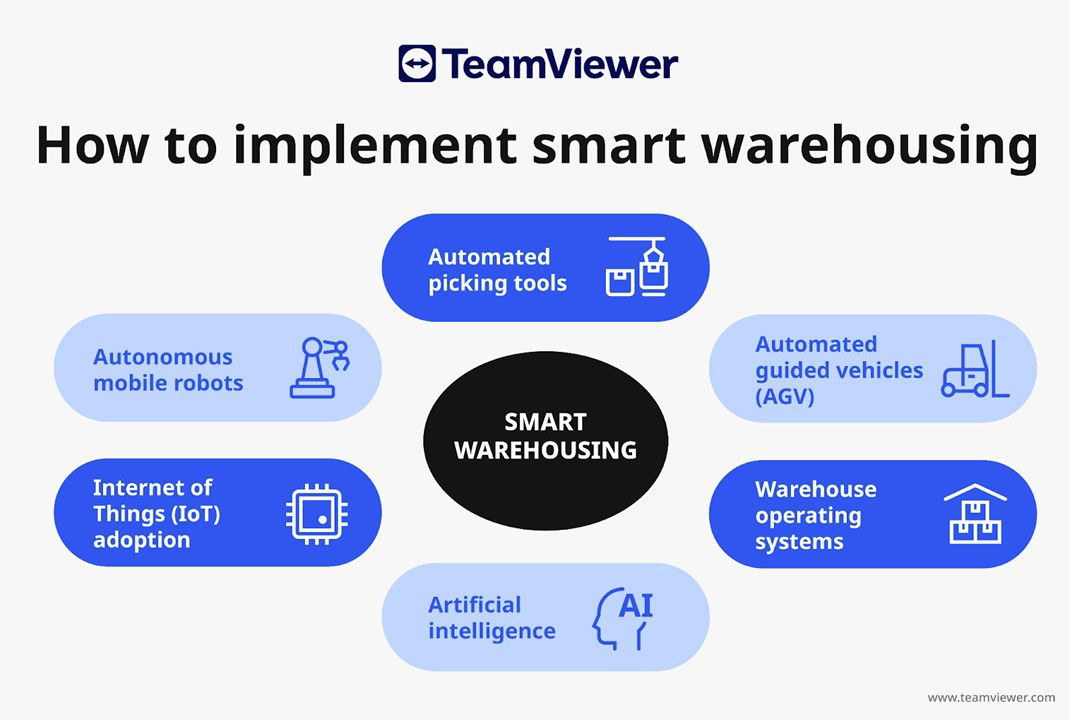
By integrating these systems, businesses unlock a smarter, safer, and more responsive warehouse environment. The following graphic shows how digital and physical automation components work together. They span information technology and equipment layers to form a fully integrated warehouse automation ecosystem.
Smart warehousing relies on a powerful combination of technologies. From intelligent robots to AI-powered analytics, these tools form the foundation of a high-performing logistics environment.
IoT sensors capture temperature, humidity, movement, and asset conditions. This data feeds directly into your warehouse management system (WMS) for proactive decision-making and real-time insights.
Autonomous mobile robots (AMRs) and automated storage and retrieval systems (AS/RS) optimize material handling with minimal human intervention. This speeds up workflows and reduces manual errors.
AI plays a key role in:
demand forecasting,
route optimization, and
labor scheduling and resource allocation.
By analyzing large datasets, AI helps logistics managers make faster, more informed decisions.
Augmented reality (AR) devices guide warehouse workers with hands-free, step-by-step instructions—significantly reducing training time and increasing picking accuracy. When paired with remote support tools, AR helps resolve issues in real time without technical experts needing to be physically present.
Together, these technologies create a connected, scalable smart warehouse ecosystem where human expertise and digital intelligence work hand in hand.
Implementing a smart logistics warehouse strategy leads to:
improved picking accuracy,
shorter delivery times,
lower labor dependency,
real-time responsiveness,
reduced operational costs, and
improved scalability for future growth.
Some roadblocks you might be facing and how to overcome them:
From global supply chains to specialized logistics environments, smart warehousing is reshaping how industries manage inventory, speed, and scalability.
By supporting the technical evolution of the retail sector, you enable fast order fulfillment, automated packaging, and real-time stock updates—even during peak seasons.
Smart warehousing supports just-in-time production, raw material tracking, and shop-floor integration—all of which benefit from IT solutions for optimized manufacturing such as remote support and AR-guided workflows.
Ensuring compliance and product safety through time-saving healthcare IT solutions, including real-time sensor tracking for cold-chain environments.
Rolling out a smart warehouse initiative requires more than just installing new technology.It demands a strategic, phased approach that aligns with business goals, systems, and people. Here’s how to do it right:
Before implementing new tools, assess your existing warehouse infrastructure and digital maturity:
What systems are already in place?
Are manual processes still prevalent?
Where do delays, errors, or inefficiencies occur?
This audit will uncover gaps and help define the roadmap for digital transformation. It’s also the perfect moment to evaluate compatibility with technologies like IoT platforms and remote support systems.
Not every process needs automation right away. Focus on the areas where tech can deliver the fastest ROI or address the most pressing pain points:
Picking and packing with robotics or AR guidance
Inventory tracking via radio frequency identification (RFID) and IoT
Remote machine monitoring to reduce downtime
Shipping and receiving process optimization
TeamViewer, for instance, supports hands-free workflows and remote troubleshooting, reducing the load on your on-site teams.
Your smart warehouse won’t perform optimally if systems can’t talk to each other. Make sure all new solutions can integrate with:
Existing warehouse management systems (WMS), enterprise resource planning (ERP), and transportation management systems (TMS) platforms
IoT devices and sensors
AR wearables and robotics infrastructure
Choose technologies with open APIs and strong vendor support. Cloud-based platforms with remote access and monitoring capabilities offer flexibility for hybrid IT environments.
Avoid a total rollout. Instead, test and scale your smart warehousing strategy using pilot programs.
Start with one location or process (such as smart picking).
Measure KPIs like error rates, order lead times, labor productivity, and system uptime.
Analyze results and make adjustments before expanding.
Clear metrics will demonstrate value quickly and build momentum across your organization.
Technology is only as powerful as the people using it. Make sure your teams aren’t just trained—but confident and supported.
Offer intuitive AR-based guidance tools for onboarding and daily tasks.
Provide real-time support via remote experts ( through TeamViewer Frontline).
Encourage feedback loops to improve tool usability.
A culture of digital empowerment leads to higher adoption rates and long-term success.
TeamViewer provides key capabilities that power your smart logistics infrastructure.
Remote troubleshooting for warehouse machines and robotics
AR-guided workflows for onboarding and manual tasks
Secure remote access to WMS, manufacturing execution systems (MES), and ERP systems
Cross-device, cross-platform compatibility
AI-powered autonomous decision-making
5G for faster, more stable IoT networks
Sustainability dashboards and carbon tracking
Integration of drone tech for internal transport
Final thoughts
The shift toward smart warehousing isn’t optional—it’s strategic. The earlier you adopt intelligent, connected systems, the faster you'll gain a competitive edge in a digitized logistics landscape.
Whether you’re exploring automation for the first time or expanding a global logistics network, TeamViewer equips you with remote support, visibility, and AR-powered tools to thrive in the smart warehouse era.
Digitize your logistics with TeamViewer Frontline’s leading remote support and AR-powered automation tools. Improve efficiency, reduce downtime, and build a smart warehouse that grows with your business.
A smart warehouse uses technologies like IoT, AI, and robotics to automate and optimize logistics operations—enabling faster, more accurate, and data-driven workflows.
Salaries vary by role. Technicians earn around $50k–$70k/year, engineers up to $120k/year, and tech-enabled warehouse workers $18–$25/hour.
Companies in industries like e-commerce, retail, manufacturing, and pharma use smart warehousing to improve efficiency, speed, and supply chain visibility.
Smart warehousing relies on IoT sensors, robotics, AI and machine learning, AR devices, and cloud-based platforms to streamline and automate warehouse operations.