Kaseya VSA delivers core RMM: remote monitoring, automated patch management, device discovery, and scripting. The limitations surface when you need a unified experience and proactive operations.
Kaseya vs ConnectWise:
Why compare RMM tools?
- RMM software used to be about connecting to a device, fixing what broke, and pushing the occasional patch. That's no longer enough. Endpoints are everywhere, workforces are distributed, and IT teams are stretched thin. The right platform should help you prevent problems, not just react to them.
- When comparing tools like ConnectWise and Kaseya, focus on what actually moves the needle: a unified platform instead of stitched-together modules, the ability to automate repetitive tasks without building and maintaining scripts from scratch, real-time remediation that acts before users notice, and digital employee experience (DEX) that shows you who's affected and why. AI should accelerate all of it, not just assist with scripting.
What Kaseya and ConnectWise actually offer
Kaseya and ConnectWise are well-known names in RMM, which is exactly why buyers put them head to head. Both have grown through acquisition into broad product families that promise to centralize IT operations, but that breadth comes with a commitment worth examining closely before you sign.
Kaseya VSA is a cloud-based RMM platform built for managed service providers (MSPs) and internal IT teams. It covers remote monitoring, automated patch management, endpoint visibility, and scripting-based automation. Much of its appeal comes from the wider Kaseya family, including Datto and IT Glue, sold as integrated bundles.
But that also means that capabilities are spread across multiple products, so teams still move between systems to finish a workflow. Users flag the same friction repeatedly: a clunky interface one user calls "software out of the mid-90s" (Capterra), unstable remote access (Capterra), and a steep learning curve (Capterra).
ConnectWise RMM is a cloud-native platform built on the company's Asio platform layer, and the newer alternative to ConnectWise Automate. It handles remote monitoring, task automation, and scripting, and it is often used by MSPs already inside the ConnectWise ecosystem of PSA (formerly ConnectWise Manage), RMM, ScreenConnect, and security tools.
It is worth comparing because the platform is still maturing, and that shows up in daily use. For some the product feels "still very much under development" (Capterra). The interface is repeatedly described as unintuitive and hard to navigate, with one user noting it "takes a lot of time to learn" (Capterra). Automation needs manual tweaking to work as expected (Capterra).
Look past the feature lists and the same three gaps appear in both platforms:
- No native DEX layer: Both focus on device-level monitoring. Neither shows you, in real time, how an issue affects employees, how often it recurses, or where to act first. Without that, prioritization stays guesswork.
- Reactive automation: Both lean on scripts and alert-triggered workflows that your team has to build and maintain. You keep fixing the same issues instead of eliminating them.
- AI that is not tied to remediation: Both offer AI-assisted scripting or limited insights. Neither connects AI to root cause analysis and automated fixes across the whole platform.
That is the opening for an alternative to ConnectWise and Kaseya. The right RMM software should unify remote support, monitoring, DEX, advanced automation, and AI in one place so your team can prevent disruptions, not just chase them. That is the case TeamViewer ONE makes.
Feature comparison
ConnectWise vs Kaseya (vs TeamViewer ONE)
(Data as of July 2026)
Strengths and weaknesses
Kaseya vs ConnectWise
Both platforms cover the RMM basics, but neither offers a native DEX layer, real-time remediation, or AI that goes beyond scripting assistance. Those gaps show up in how teams actually work day to day.
Kaseya
- Broad product family: RMM, backup, documentation, and security available across the Kaseya ecosystem
- Automated patching: OS and third-party patch management across Windows, Mac, and Linux
- Scripting and automation: Extensive procedure builder and policy-based workflows
- Device coverage: Supports Windows, macOS, Linux, iOS, and Android
- Fragmented platform: Capabilities spread across VSA, Datto, and IT Glue, requiring tool switching to complete workflows
- No native DEX layer: Device-level monitoring only, no visibility into user impact
- Reactive automation: Script and alert-triggered workflows your team has to build and maintain
- Interface friction: Repeatedly described as clunky and outdated on Capterra and GetApp
- Unstable remote access: Live Connect draws recurring complaints about instability (Capterra)
- Long contracts: Multi-year commitments flagged as a frequent pain point by reviewers (Capterra)
- Slow customer support: Customer complaints about response times (GetApp)
ConnectWise
- Asio platform: Connects RMM, PSA, ScreenConnect, and security under one layer
- Broad patching coverage: Automated patching across 7,000+ third-party applications
- MSP-focused workflows: Tight integration with PSA for ticketing and billing
- AI-assisted scripting: Generates PowerShell, batch, and bash scripts with approval
- No native DEX layer: Device-level monitoring only, no user experience visibility
- Reactive automation: Script and ticket-driven workflows requiring manual configuration and upkeep (G2)
- Clunky interface: Consistently described as unintuitive, with a steep learning curve across Capterra
- Patching gaps: Limited flexibility in patching per customer, with basic reporting features still missing (G2)
- Feature gaps: Key capabilities and integrations still missing, with the platform continuing to evolve incrementally rather than delivering a complete out-of-the-box experience (Capterra)
- Support inconsistency: Slow response times flagged repeatedly across Capterra and G2
Which RMM platform wins?
Kaseya and ConnectWise both get the job done for specific use cases. But when reactive support and fragmented workflows are holding your team back, TeamViewer ONE is the stronger choice. Here is why.
-
Kaseya: Where it works and where it stops
Kaseya works for MSPs and IT teams that want a broad product family and are comfortable buying into bundles and longer contracts.
It stops when you need a single unified platform, native DEX, and automation that prevents issues instead of reacting to them. As one user put it, the platform "is not as robust as other RMM platforms, so you may find yourself needing to supplement the features with another product" (Capterra). -
ConnectWise: Where it works and where it stops
ConnectWise works for larger, established MSPs that want PSA, RMM, and remote access under one vendor and have a dedicated admin to configure it.
It stops when you want fast setup, a modern unified experience, and an experience layer that connects issues to users. Reviewers consistently describe a steep learning curve and a product still filling feature gaps: "some features are missing, or in some cases lack sufficient customer support" (G2). -
TeamViewer ONE: Why it stands out
If basic RMM software leaves you stitching tools together and reacting to tickets, TeamViewer ONE is the most complete Kaseya alternative and ConnectWise alternative on the market.
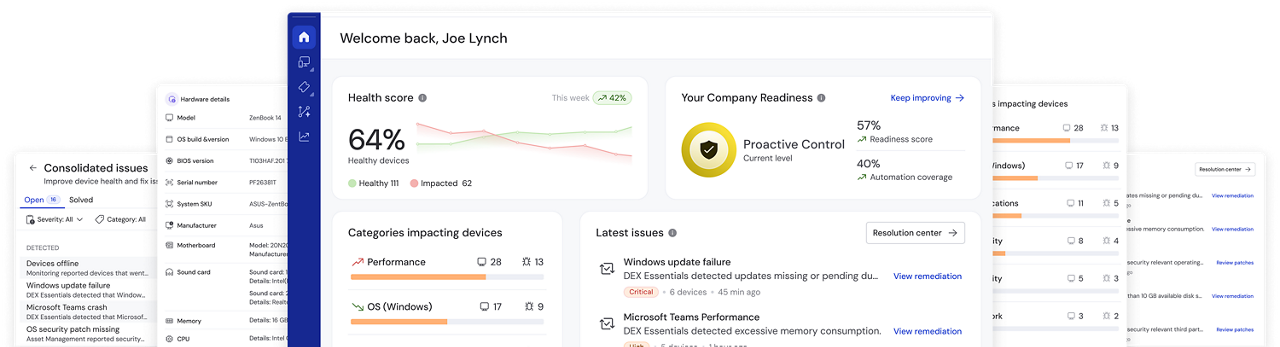
It unifies remote connectivity, DEX, automation, and AI in one cloud-native platform. Teams detect, investigate, and resolve issues without switching tools, and easily prevent recurring problems.
The recognition speaks for itself: TeamViewer ranked #2 on G2’s 2026 Best IT Infrastructure Software list and is a Leader in the 2026 Gartner® Magic Quadrant™ for DEX Management Tools.
What makes TeamViewer ONE the clear winner for modern IT teams
More than 635,000 customers rely on TeamViewer solutions worldwide.
If you are looking for a Kaseya alternative or a ConnectWise alternative that goes beyond traditional RMM, TeamViewer ONE is built for exactly that: a unified platform that shifts your team from reactive support to proactive operations.
-
No more jumping between tools
TeamViewer ONE brings remote access, endpoint management, DEX, and AI into one platform. Your team detects, investigates, and resolves issues without jumping between tools. That is a direct answer to the module switching that slows both Kaseya and ConnectWise.
-
Fix problems before employees notice them
DEX is the layer both competitors lack. TeamViewer ONE shows how IT issues affect employees in real time. Beyond device telemetry, you see who experiences problems, how often, and where to act first. Slow logons and failing devices get fixed before users get frustrated.
-
Stop fixing the same issues twice
TeamViewer ONE automates fixes based on real-time insights and recurring patterns. Pre-built, no-code workflows cut manual effort and stop repetitive issues from coming back. You spend less time maintaining scripts and more time preventing problems.
-
Intelligence built into every workflow
AI is embedded across the platform, and it is included in every package. Teams can use Tia, the TeamViewer Intelligent Agent, to query their environment and speed up root cause analysis. AI-powered Session Insights automatically document sessions and surface patterns. This is AI tied to remediation, not just scripting.
-
Enterprise-grade protection without the complexity
TeamViewer ONE is secured by end-to-end 256-bit AES encryption, two-factor authentication (2FA), conditional access, and single sign-on (SSO), plus comprehensive audit logging and a zero-trust architecture. It supports HIPAA and GDPR compliance along with SOC 2.
Top-rated, award-winning software solution

Here's what TeamViewer ONE customers are saying
See what TeamViewer ONE can do for your team
You have seen where Kaseya and ConnectWise stop. Now see what a truly unified platform feels like.
Frequently asked questions (FAQ)
Focus on platform architecture, native remote support, automation depth, real-time remediation, DEX, AI capabilities, security, and pricing model. The best RMM software unifies these in one platform so your team can prevent issues instead of just reacting to alerts and tickets.
The best RMM software for MSPs depends on your stack, but look for native remote access, no-code automation, and DEX. Many RMM software examples lock you into one ecosystem. TeamViewer ONE unifies connectivity, automation, and AI without that tradeoff.
The best RMM software for small business is one that scales without growing complexity. Endpoint-based pricing, fast setup, and built-in automation matter most. TeamViewer ONE delivers enterprise capabilities in a platform lean teams can actually run day to day.
Kaseya centers on its broad product family across VSA, Datto, and IT Glue, sold in bundles. ConnectWise builds around its Asio platform, with PSA and ScreenConnect at the core for MSPs. Both spread capabilities across modules rather than one unified platform. What they share is more telling than what separates them: neither offers native DEX, real-time remediation, or AI tied to root cause analysis.
Both lean toward MSP workflows. ConnectWise depends heavily on PSA and ScreenConnect, while Kaseya pushes its bundled ecosystem. For internal IT teams that want one unified platform with DEX and prevention, TeamViewer ONE is often the stronger fit.
The best alternative to Kaseya is a unified platform that does not spread capabilities across separate products. TeamViewer ONE combines native remote support, DEX, automation, and AI in one place, with real-time remediation Kaseya does not offer.
TeamViewer ONE unifies remote connectivity, DEX, automation, and AI, with AES-256 encryption, conditional access, and SSO built in. It shifts your team from reactive support to prevention, and it is trusted by more than 635,000 customers worldwide.
Yes. TeamViewer ONE is cloud-native and supports flexible, endpoint-based licensing, so you can roll it out across your environment in stages. A consultation maps your current setup and a migration path that keeps operations running.