
10 best digital employee experience software tools in 2026

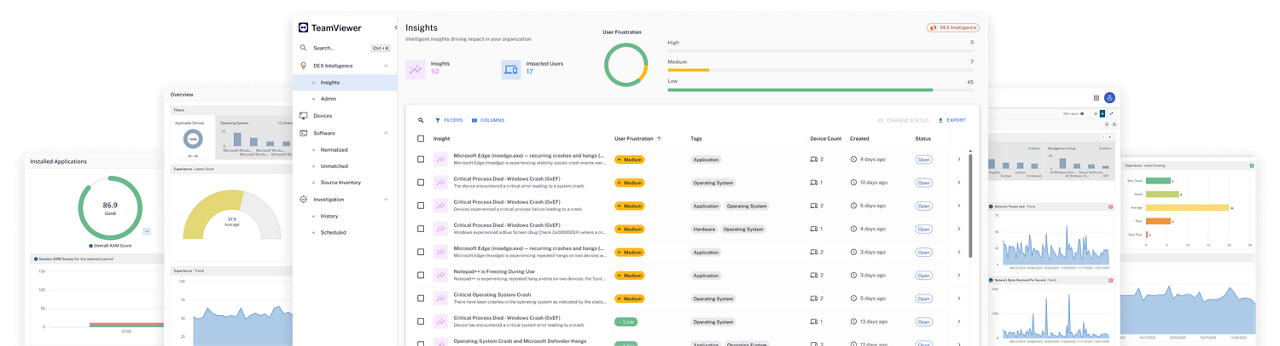
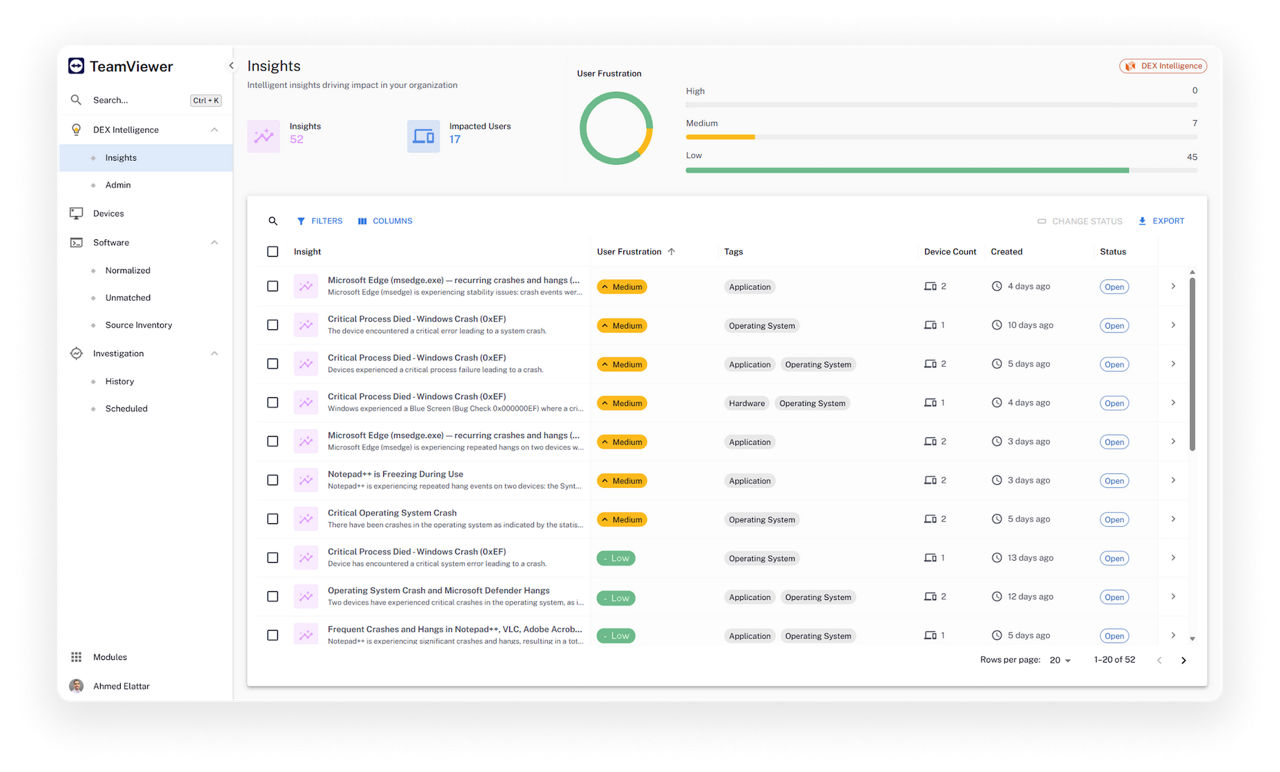
Digital employee experience (DEX) software tools help IT teams monitor and optimize how employees interact with technology across devices, applications, and networks. The best DEX solutions combine real-time monitoring with automated remediation to fix issues before they disrupt work.

This comparison reviews 10 leading DEX platforms, including TeamViewer, Nexthink, Aternity and others. It considers  features, benefits, and limitations.

  • What is the best DEX software in 2026?

    TeamViewer DEX stands out for real-time visibility, offline remediation, broad device and SaaS coverage, and more than 2,000 pre-built automations at a predictable cost.

    Traditional DEX tools like Nexthink, Aternity, Lakeside, and ControlUp offer solid analytics but often rely on slower data cycles or require more setup and specialist skills.

    Network-focused platforms like Catchpoint and ThousandEyes add SaaS and internet visibility but don’t remediate endpoint issues.

    UEM/XEM suites such as Ivanti and Tanium include DEX features but increase complexity and overall cost.
  • Who is this list for?

    This comparison is designed for IT leaders, operations managers, and decision-makers from SMBs and enterprises who need to:

    • Solve support challenges at scale: Reduce ticket volume and fix issues faster across distributed teams
    • Monitor hybrid work environments: Track device health, application performance, and user experience regardless of location
    • Control costs: Find transparent, predictable pricing instead of complex enterprise quotes
    • Deploy efficiently: Implement solutions without lengthy rollouts or specialized skills
    • Support diverse environments: Manage Windows, macOS, Linux, mobile, and IoT endpoints from one platform
    • Scale operations: Choose platforms that grow from hundreds to thousands of endpoints without performance degradation

Comparison

The best digital employee experience software in 2026 direct comparison

(Data as of December 2025)

There is a vast ecosystem of digital employee experience tools, but not all are created equal. The ten providers below are the best of suite tools for IT operations of all sizes.

TeamViewer

Nexthink

Aternity

ControlUp

Lakeside

Ivanti Neurons

Nanoheal

Catchpoint

ThousandEyes

Tanium

Data collection speed

Instant (milliseconds)

Minutes

15-60 seconds

Minutes

Up to 30 min (complex)

Real-time

15-60 seconds

15-60 seconds

15-60 seconds

15-60 seconds

Offline remediation

✔︎

Requires online connectivity

Limited

✔︎ (auto-remediation on reconnect)

Limited (primarily online)

Requires online connectivity

OOTB automations

2,000+

Hundreds

Hundreds

Not available

Few hundred

Extensive (self-healing)

750+

Limited (testing/alerting)

Limited (testing/alerting)

500

Real-time architecture

Event-driven

Polling-based

Polling-based

Client-Server

Polling-based

Cloud-native

Cloud-based SaaS

Cloud-based IPM

Cloud-native DEM

Agent-based

AI-driven insights

✔︎ (DEX Intelligence)

ML/AI recommendations

Limited

Not supported

Limited

✔︎ (predictive analytics, DEX scoring)

✔︎ (self-healing, anomaly detection)

✔︎ (anomaly detection, baselines)

✔︎ (AI-native detection)

Not available

SaaS/UCaaS monitoring

✔︎ (Exoprise, TeamViewer Application Experience Management/ AMX)

Limited

Basic browser only

✔︎

✔︎

✔︎  (M365, Salesforce, Webex)

✔︎ (M365, Salesforce, Webex)

Not supported

VDI support

✔︎ (Citrix, Citrix Cloud)

✔︎ (Citrix and MS AVD)

Strong (Citrix, VMware, AVD, IGEL)

Strong (Citrix, AVD, CVAD, Omnissa)

Strong (Citrix)

✔︎

Not documented

Not documented (network/app focus)

Limited (network/app focus)

VM only

Compliance enforcement

Extensive, real-time

Limited

No enforcement

✔︎

✔︎

✔︎

✔︎

✔︎

Certifications

TX-RAMP, FedRAMP (in progress), SOC2, ISO 27001, VPAT 508, FIPS 140-2

TX-RAMP, FedRAMP (in progress)

No TX-RAMP or FedRAMP

Not TX-RAMP

Not TX-RAMP/FedRAMP

FedRAMP, SOC2, ISO 27001 (no TX-RAMP)

Not publicly available

Not publicly available

Part of Cisco portfolio

FedRAMP

TeamViewer DEX is a comprehensive digital employee experience platform combining real-time endpoint monitoring, actionable insights, and automated remediation. Built on 25+ years of remote connectivity expertise serving 650,000 customers globally.

Features

  • Instant data collection in milliseconds with event-driven architecture
  • Offline remediation; queued remediations execute upon reconnection
  • 2,000+ pre-built automations
  • No-code automation creator
  • AI-driven DEX Intelligence with guided recommendations
  • Holistic visibility (endpoints, SaaS, UCaaS, VDI, network, and ISP)
  • Native remote support
  • Cross-platform support for Windows, macOS, Linux
  • Self-service remediation
  • Enterprise compliance

Benefits

  • Data collection and automation execution happen in milliseconds, not minutes
  • Works offline, ensuring continuous compliance
  • Supports diverse digital workplace scenarios due to cross-platform connectivity
  • Largest automation library covering monitoring and remediation
  • Policy-based approach eliminates PowerShell requirements
  • Cost-effective with modular pricing and no platform lock-in
  • Users describe TeamViewer as "very easy to use" for diverse workflows from troubleshooting to client meetings (Source: G2)
  • Broad coverage that extends IT reach to any device without complex setup

Nexthink is a dedicated DEX data analytics platform focused on endpoint event capture and user sentiment correlation.

Features

  • Data collection with minutes delays
  • Polling-based architecture
  • Hundreds of pre-built automations
  • ML/AI-based recommendation engine
  • DEX scoring
  • Actionable insights
  • Captures endpoint events and user feedback

Benefits

  • Established presence in DEX market
  • Correlates user sentiment with technical telemetry
  • Provides historical analytics

Limitations

  • Mastering certain aspects of the platform, such as Nexthink Query Language, requires a steep learning curve (Source: G2)
  • Cannot remediate issues when devices are offline, requires online connectivity
  • Requires dedicated development resources for setup and onboarding processes (Source: G2)
  • The historical data is only stored for 30 days, which might not provide an accurate enough picture (Source: G2)
  • On the more expensive end

Aternity is a tool for endpoint experience monitoring with focus on tracking employee application usage patterns and remote work visibility.

Features

  • Data collection and reporting with 15-60 second delays
  • Polling-based architecture
  • Hundreds of automations available
  • Requires PowerShell and VBScript
  • Captures granular performance data (click-to-render, app telemetry, network hops)
  • Tableau integration for dashboards
  • VDI support across Citrix, VMware Horizon, Microsoft AVD, IGEL

Benefits

  • Tracks which applications remote employees use and how long they're active
  • Provides per-user, per-device experience views
  • Unified agent for network and application monitoring

Limitations

  • Real-time data collection can take minutes
  • Requires additional resources to set up all features (Source: G2)
  • Could benefit from a more intuitive interface (Source: G2)
  • Configuration requires experimentation to fine-tune employee UX
  • The total pricing is on the higher end

ControlUp is a real-time end user computing (EUC) monitoring platform with DEX scoring, device health scores, and low-code intelligent automation, consolidated into ControlUp ONE platform.

Features

  • Data collection takes minutes for online devices
  • Client-server architecture
  • Captures machine performance metrics
  • VDI/DaaS focused with support for Citrix, AVD, CVAD, Omnissa
  • Device health scores and employee sentiment
  • Synthetic testing capabilities

Benefits

  • Designed for fast troubleshooting in VDI environments
  • Unified DEX scoring reduces tool sprawl for EUC-heavy environments
  • Real-time EUC monitoring

Limitations

  • Requires significant upfront effort to configure and extract value
  • Some features need maturing to accommodate enterprise needs (Source: G2)
  • Script-based automation requires additional cost (Source: G2)
  • DEX-specific templates are limited; RBAC must be manually customized
  • No certifications for regulated industries (not TX-RAMP)
  • Requires devices to be online for remediation
  • Feature lists strongly oriented around VDI/DaaS and Windows endpoints

Lakeside is an always-on endpoint monitoring platform collecting detailed telemetry to produce health and productivity scores. It is designed for large estates requiring granular device and user behavior data.

Features

  • Queries 10,000 datapoints every 16 seconds
  • Offline scripts and sensors
  • Data storage
  • Windows, macOS, Linux, Chrome, and mobile support

Benefits

  • Three-year data retention for historical root cause analysis
  • Can run some scripts and sensors offline
  • Captures granular endpoint data

Limitations

  • Originally a monitoring tool, not purpose-built for DEX
  • Cannot remediate issues while device is offline (analysis only)
  • Queries and automations can take up to 30 minutes in large environments
  • Agent instability and authentication problems requiring lengthy server restarts to resolve (Source: G2)
  • Pre-built recommendations require manual implementation (Source: G2)
  • Historical data is "compressed," so you might lose some vital information (Source: G2)

Ivanti is a unified endpoint and user experience management tool with remote control capabilities, typically deployed as part of a larger UEM/ITSM stack.

Features

  • Data collection from endpoints, applications, and networks
  • Automatic remediation when devices reconnect
  • Self-healing capabilities and automated workflows
  • Predictive analytics
  • Monitors SaaS apps and digital workplace environments

Benefits

  • FedRAMP authorized with multiple security certifications
  • Self-healing capabilities
  • DEX scoring system provides packaged metrics

Limitations

  • Some users highlight clunky interface (Source: Reddit)
  • Analytics might need improvement (Source: TopAdvisor)
  • Capabilities spread across multiple modules (Source: Hexnode)
  • Steep learning curve (Source: Gartner)
  • Pricing is more expensive
  • Not positioned as standalone DEX product

Nanoheal is an AI-driven digital experience automation platform with predictive self-healing, proactive issue resolution, and zero-code automation.

Features

  • AI-driven healing for endpoints
  • Device fleet management
  • 750+ pre-built automations
  • Cloud-based SaaS platform
  • Experience score (AIM-X) blending device and survey data
  • Built-in BI layer

Benefits

  • 750+ pre-built automations
  • Zero-code automation
  • Built-in BI layer for non-technical stakeholders

Limitations

  • Limited offline remediation capabilities
  • No government or security certifications mentioned
  • Fewer features compared to more established providers
  • Might need additional resources and integrations to fully fit in enterprise tech ecosystems (Source: Gartner)
  • Less well known compared to established vendors, which can slow internal buy-in

Catchpoint is an internet performance monitoring platform driven by a large global agent network. It provides synthetic and real-user monitoring for SaaS, web apps, and internet dependencies.

Features

  • Real-time synthetic and Real User Monitoring (RUM)
  • Cloud-based Internet Performance Monitoring (IPM) platform
  • AI-powered anomaly detection and smart baselines
  • Comprehensive SaaS monitoring (Microsoft 365, Salesforce, Webex)
  • Global vantage points for network visibility

Benefits

  • Detects customer-impacting performance regressions
  • Global coverage for detecting internet-level issues
  • Compares user data with synthetic tests to pinpoint whether issues are internal or internet-related

Limitations

  • No automated remediation capabilities (monitoring only)
  • Initial setup and onboarding can be time-consuming (Source: G2)
  • Limited OOTB automations
  • Cost can grow quickly for broad global coverage (Source: G2)
  • Internet-focus does not replace endpoint-level DEX visibility

ThousandEyes is a network and internet path visibility platform using synthetic tests and BGP monitoring. It is often integrated with Cisco gear and licensing for hybrid network and SaaS visibility.

Features

  • Real-time monitoring with synthetic tests, RUM, and endpoint agents
  • Cloud-native Digital Experience Monitoring (DEM) platform
  • AI-native technology for issue detection and correlation analysis
  • Comprehensive SaaS and UCaaS monitoring (Microsoft 365, Salesforce, Webex)
  • Network path visibility

Benefits

  • Network path visibility helps pinpoint where user experience degrades
  • Integrates into automation tools for faster remediation
  • Flexible licensing in Cisco environments (some DNA licenses include tokens)

Limitations

  • No automated remediation capabilities
  • Limited VDI support (network/application focus)
  • No specific government certifications mentioned
  • Users describe the price as on the higher end (Source: G2)
  • Requires additional resources for setup and onboarding (Source: G2)

Tanium is a converged endpoint management platform. It positions DEX as part of a broader security-oriented XEM platform with autonomous endpoint management.

Features

  • Data collection with 15-60 second response
  • Patch management module (Tanium Patch) with automation and orchestration
  • 500 out-of-box automations
  • ~10 use case templates available
  • Remote control and agent-based telemetry modules

Benefits

  • Can displace Microsoft Endpoint Manager for Windows management
  • Native patch management
  • Scalable architecture

Limitations

  • Not purpose-built for DEX; lacks machine responsiveness data collection
  • Consumes significant system resources (Source: Reddit)
  • Cannot be purchased as standalone solution
  • Limited to endpoint visibility (no SaaS, UCaaS, or comprehensive VDI monitoring)
  • Steep learning curve (Source: G2)

Advantages of using digital employee experience software

Digital employee experience software transforms how IT teams support employees by shifting from reactive firefighting to proactive management. Here's what organizations gain:

  • Boosted productivity

    DEX platforms continuously monitor devices, applications, and networks to detect problems in real-time. When a laptop's disk space drops to critical levels, the software can automatically clear temporary files before the device slows down. When an application starts crashing, IT receives alerts before multiple employees report issues. This means your employees spend more time working and less time waiting for IT support.

  • Reduced IT workload

    Automation handles repetitive fixes without human intervention. Organizations using platforms with 2,000+ pre-built automations, such as TeamViewer, can deploy fixes immediately without writing scripts or building custom solutions. This reduces ticket volume by 30-50% in many deployments.

  • Improved employee satisfaction

    When technology works consistently, employees can focus on their work instead of wrestling with IT problems. DEX software tracks the actual user experience to measure how responsive applications feel, how long tasks take, and where friction occurs.

    Employee feedback surveys integrated into DEX platforms capture frustration before it escalates, allowing IT to address problems that traditional monitoring misses.

  • Full visibility

    Modern work happens across dozens of collaboration tools, devices, and networks. DEX platforms with holistic monitoring (endpoints + SaaS + UCaaS + network + ISP) show the complete picture. Without this visibility, IT teams waste hours troubleshooting the wrong components.

  • Strengthened compliance and security

    DEX platforms detect when devices fall out of compliance: missing patches, incorrect configurations, unauthorized software, and automatically remediate the issues.

    This matters especially for offline devices. Platforms with offline remediation ensure policies are enforced even when devices disconnect from the network, preventing remote access security risks.

How organizations use DEX software

Global infrastructure optimization

Schneider Electric automated Windows 10 migration for 120,000+ users across 100+ countries using TeamViewer DEX. The platform eliminated 400 distribution points, reduced infrastructure complexity by 90%, and saved €100,000 annually in maintenance costs.

Data-driven cost savings

Carollo Engineers uses TeamViewer DEX's real-time data to identify which devices don't need upgrades, generating substantial cost savings. The platform retrieves data instantly from remote workers, unlike traditional tools that provide days-old information.

Enterprise standardization and agility

Bacardi, the largest privately held spirits company, brought infrastructure management in-house using TeamViewer DEX to prepare for Windows 10. The platform enabled global standardization, improved SCCM management, and delivered company-wide agility with cost savings through centralized control.

These implementations share common success factors: rapid deployment (days, not months), offline/remote capability without VPN dependency, infrastructure cost reduction, and seamless integration with existing tools like ServiceNow, Power BI, and SCCM.

Criteria for choosing the right digital employee experience software

Selecting DEX software means evaluating the capabilities that help you support employees effectively. When choosing a DEX platform, consider the following criteria:

Criteria

Conclusion

Digital employee experience software helps to move IT teams from reactive support to proactive management by monitoring devices, applications, and networks in real-time. The best platforms combine comprehensive visibility with automated remediation to fix issues before they impact employees.

Choosing the right DEX tool will depend on your budget, constraints, and company needs. Monitoring-focused platforms like Catchpoint and Cisco ThousandEyes provide visibility but lack automated endpoint remediation. Enterprise DEX suites including Nexthink, Aternity, ControlUp, Lakeside, Ivanti, Tanium, and Nanoheal offer varying automation levels but typically require higher investment, longer deployments, or specialist skills to unlock value.

For organizations seeking reliable remote support, cross-platform monitoring, and practical deployment without multi-month rollouts, TeamViewer DEX provides a straightforward solution that users describe as easy to implement and broadly useful across diverse IT environments.

Frequently asked questions (FAQ)

DEX software reduces IT costs while improving productivity. It does so by detecting and fixing issues automatically before they disrupt work. Organizations typically see 30-50% fewer support tickets, letting IT teams focus on strategic projects while employees experience fewer interruptions.

Real-time monitoring detects problems in milliseconds and fixes them automatically, restarting applications before devices freeze and clearing disk space before performance degrades. Offline remediation ensures policies are enforced even when devices disconnect, maintaining compliance without IT intervention.

DEX platforms continuously monitor devices for missing patches, configuration drift, and policy violations, then automatically remediate issues. Offline remediation prevents security bypasses by enforcing policies even when devices disconnect, maintaining compliance across distributed workforces..

DEX platforms capture sentiment through surveys, post-incident feedback, and experience scoring. AI correlates technical issues with user feedback to identify patterns, while self-service features empower employees to fix common problems immediately without submitting tickets. This helps to improve employee sentiment by reducing time spent waiting for IT support and ensuring faster issue resolution.