What is digital experience monitoring? Benefits, tools, and use cases


Digital experience monitoring is a performance analysis discipline that focuses on the availability, performance, and reliability of business applications, networks, and infrastructure from the user's viewpoint. In plain terms: DEM monitors whether people can actually get their work done with the digital tools in front of them.
A digital experience monitoring platform pulls together data from every layer of the delivery chain: endpoint, network path, application, and real user behavior, and correlates those signals into a unified view. Gartner predicts that at least 60% of IT leaders will use DEM to measure digital experience from the user’s viewpoint by the end of 2026.
DEM becomes critical the moment IT stops being able to answer why digital employee experience is poor. The practical trigger tends to be a rising volume of user complaints, combined with growing dependence on services IT doesn't own. At that stage, the absence of delivery-chain visibility starts showing up in productivity loss, escalations, and customer churn.
The cost of getting this wrong is measurable. 80% of workers say they lose valuable work time to dysfunctional IT. That's hours lost on fixing issues and context switching.
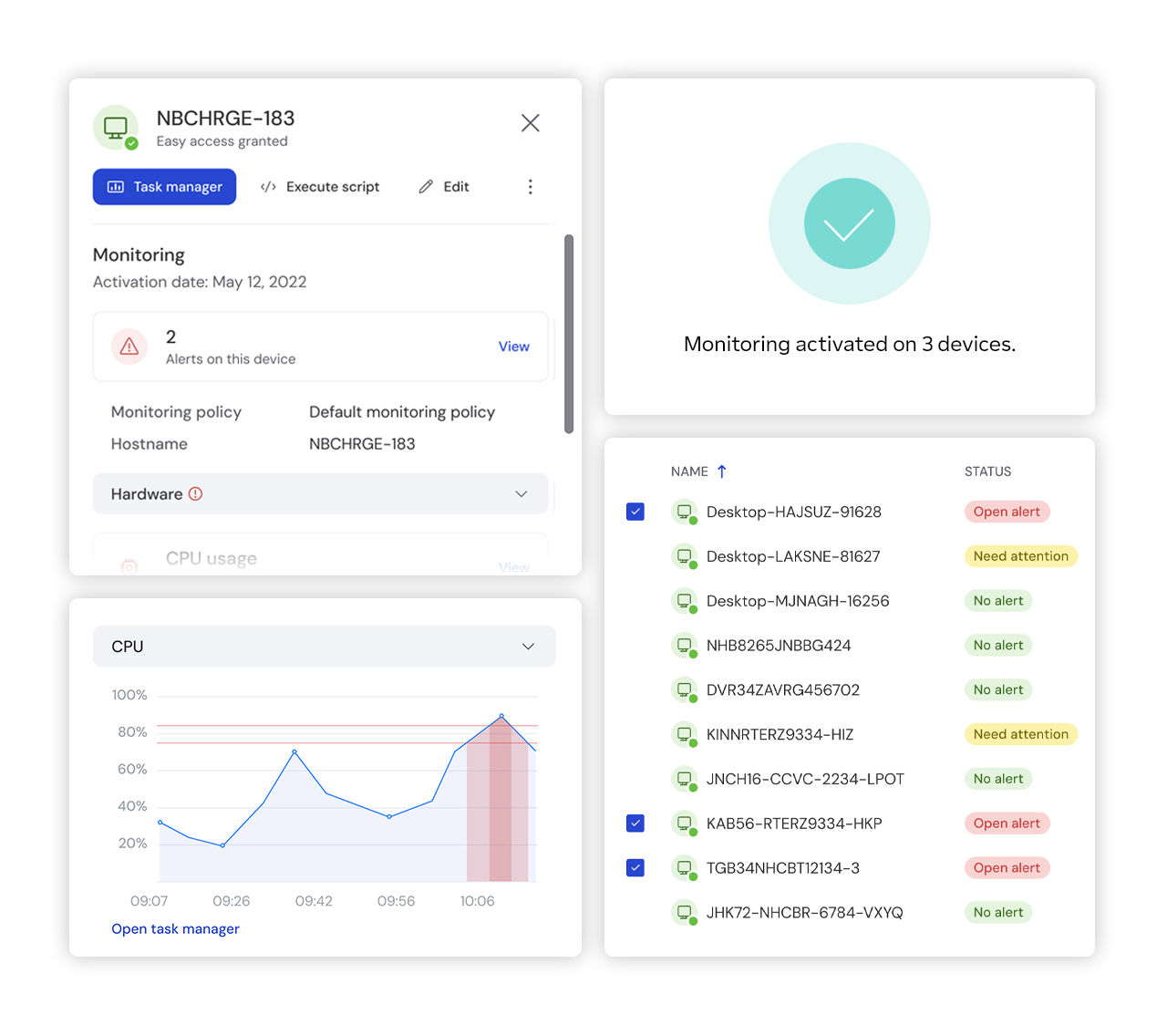
Traditional monitoring was architected around one question, "is the component healthy?" Infrastructure tools answer that state well. What they were never designed to answer is whether the person at the endpoint is getting the performance they need, a different question, and one that has drifted further from infrastructure metrics as work, applications, and performance data have all moved outside the corporate perimeter.
Employees connect from home networks, co-working spaces, and mobile hotspots. Every connection introduces new variables: consumer-grade routers, residential ISPs with variable peering, Wi-Fi signal strength at the user's kitchen table. Traditional monitoring has no line of sight into those.
The average enterprise now manages more than 300 SaaS applications, and the business-critical ones might run on infrastructure IT doesn't own. When Salesforce slows down for a user in one region, or a Zoom CDN edge degrades for a team in another, there's no internal dashboard to consult. The performance variables live inside someone else's cloud.
Two-thirds of organizations run more than 40% of their workloads across multiple clouds. Every additional provider adds a transit path, a new set of failure modes, and another gap between what internal tools can measure and what users actually experience.
Traditional monitoring assumes uniformity that no longer exists. Users switch between devices, connect over mobile hotspots, work from hotels, and occasionally borrow a family member's computer for a quick check-in. Every user's experience depends on a unique combination of hardware, software, and connectivity variables.
Each monitoring tool watches one layer, and today's issues rarely stay in a single layer. A slow Teams call might involve a CPU-taxed laptop, a jittery home router, a congested ISP transit link, and an overloaded CDN edge. Each monitor reports its layer as healthy because each layer, in isolation, is within bounds. Only a platform that correlates signals across all four sees what the user is experiencing. DEM software is that platform.
DEM works by collecting performance and experience data from every layer of the delivery chain and correlating those signals into a single view of what one user, on one device, experiences at one moment.
Four component types feed the picture, and the output is a cross-layer picture that tells IT exactly where in the chain performance is degrading, and for whom:
The value of DEM technologies shows up in outcomes but those outcomes depend on a specific set of capabilities working together. Here's what you can expect from digital monitoring tools.
When endpoint, network, application, and user signals arrive in the same view, indexed to the same user at the same moment, the handoff disappears. Root cause analysis runs programmatically, across what used to be five separate dashboards, and diagnosis that took hours takes minutes.
You switch from being reactive to proactive. Performance baselines define what normal looks like for each app, location, and user segment. Proactive alerts fire when metrics drift outside those ranges, so IT spots issues in the same window the user does. Friction events that used to pile up into hours of weekly lost time get caught and fixed before they compound.
Digital performance issues have a significant impact on employee productivity and satisfaction. At least 28% of employees consider quitting due to technology challenges, and 69% believe dysfunctional IT contributes to turnover. DEM platforms close the loop between monitoring and fixing. Remote troubleshooting lets IT access the affected endpoint in-session, apply configuration changes, and resolve issues without the user raising a ticket at all.
External user monitoring captures the checkout slowdowns, mobile crashes, and login failures that drive churn, correlating them to specific regions, devices, and browser versions so fixes land where they matter. DEM catches these signals before they show up in abandonment rates.
Patterns emerge across weeks and months: which applications consistently underperform for which segments, which locations have chronic latency, where infrastructure investment would have the highest experience impact. Monitoring data turns into planning input, and IT moves from support function to strategic advisor.
SLAs measure process compliance (was the ticket closed on time). XLAs measure whether users actually had a good experience. DEM as the measurement infrastructure makes XLAs operationally viable. Without the cross-layer, user-side visibility DEM provides, experience commitments stay theoretical. With it, they become something IT can measure, report on, and improve against.
Most DEM platforms combine several tool categories:
The shift the market is making is away from stitching these categories together manually and toward unified platforms. More than two thirds of teams use multiple observability technologies. At enterprise scale, tool sprawl is standard, and it's what makes root cause analysis slow.
Leading digital experience monitoring providers like TeamViewer provide a unified approach. TeamViewer DEX surfaces endpoint, application, and network signals in a unified view, and connects monitoring directly to remediation. When DEM identifies an issue, IT can access the affected endpoint in the same session and apply a fix, keeping diagnosis and resolution inside one workflow.
Final thoughts
The shift from isolated monitoring tools to a unified digital employee experience monitoring is the real story behind DEM. Fragmented tools each report their layer as healthy while the user satisfaction degrades in the gaps between them. A unified platform closes those gaps: one view, one user context, one timeline.
If your IT team is still manually correlating data across five dashboards to diagnose a slow app, the gap between what you're monitoring and what your users are experiencing is measurable. And closing it starts with consolidating the layers you're already watching into a platform that can actually see them together.
DEM collects telemetry across the delivery chain and correlates it in one platform. Synthetic tests simulate user actions proactively. End user experience monitoring captures actual behavior. Endpoint agents track device health. Network path diagnostics pinpoint where performance is degrading.
Network monitoring watches infrastructure health (switches, routers, servers) to confirm systems are up. DEM watches what users experience across the full delivery chain. Network monitoring answers "is the system up?"; DEM answers "is the user productive?"
RUM passively captures what real users experience in their actual conditions, it tells you what happened. Synthetic monitoring actively runs scripted tests on a schedule, it tells you what would happen. Complete DEM uses both.
Hybrid workers access apps over home ISPs and personal networks. Server logs can't tell IT whether a slow app is the device, router, ISP, or application. DEM extends visibility to the endpoint and full user-to-app path.
Evaluate coverage across all four layers: endpoint, network, application, real user. Does the platform correlate signals in one view? Does it combine synthetic and RUM? Does it integrate with remediation? TeamViewer DEX is one of the best digital monitoring solutions on the market.