Atera vs ConnectWise

Atera vs ConnectWise: Find the right platform for modern IT needs

Evaluating Atera and ConnectWise for your IT operations?
Our feature-by-feature analysis provides an overview of each product's offered features. See how they compare, and why many IT teams end up choosing TeamViewer ONE instead.

Why compare Atera and ConnectWise?

Choosing the right Remote Monitoring Management (RMM) platform means looking beyond feature lists.
The real question is whether a solution can support how your IT team actually operates: managing endpoints, automating workflows, and resolving issues at scale.

Both Atera and ConnectWise cover core RMM needs, but serve different team sizes and operational models.

Basic overview

Atera bundles RMM, PSA, ticketing, and billing into one platform. Small IT teams and MSPs with straightforward environments often use it as a starting point. Per-technician pricing keeps costs predictable at smaller scales.

The trade-off is RMM depth. Native remote support isn't included, leaving teams dependent on third-party integration. Deeper remediation requires manual scripting rather than out-of-the-box automation.

ConnectWise RMM covers core IT management, including endpoint monitoring, patch management, and policy-based automation. This makes it a workable choice for MSPs already operating within its ecosystem.

Outside that context, the limitations show. Remote support runs through ScreenConnect rather than a native integration, and automation is script- and policy-driven, requiring significant manual configuration to set up and maintain.

The gap becomes clear when you look beyond basic RMM: neither Atera nor ConnectWise offers a native digital employee experience (DEX) layer, both rely on reactive, alert-driven automation, and neither ties AI to actual remediation nor root cause analysis. Atera limits it to helpdesk efficiency, ConnectWise to scripting support. Both also require teams to move between tools to complete core workflows.

For IT teams that need proactive issue resolution, real visibility into user impact, and AI that actually drives outcomes, platforms like TeamViewer ONE are worth a closer look.

Feature comparison

ConnectWise vs Atera (vs TeamViewer ONE)

(Data as of June 2026)

ConnectWise RMM
Atera
TeamViewer ONE

Pricing model

Endpoint-based

Per-technician

Endpoint-based

Platform architecture

Multi-tool ecosystem

Bundled RMM, PSA, and ticketing

Single integrated platform: RMM, DEX, AI, remote support, ITAM

Native remote support

Via ScreenConnect

Via third-party integrations

✅ All major OS and device types

Endpoint monitoring & patching

Automation

Script- and policy-based

Scripting required for deeper automation

Out-of-the-box, no-code, policy-based

Real-time remediation

Alert- and rule-driven (reactive)

✅ Insight-driven

Digital Employee Experience (DEX)

❌ Device-level monitoring only

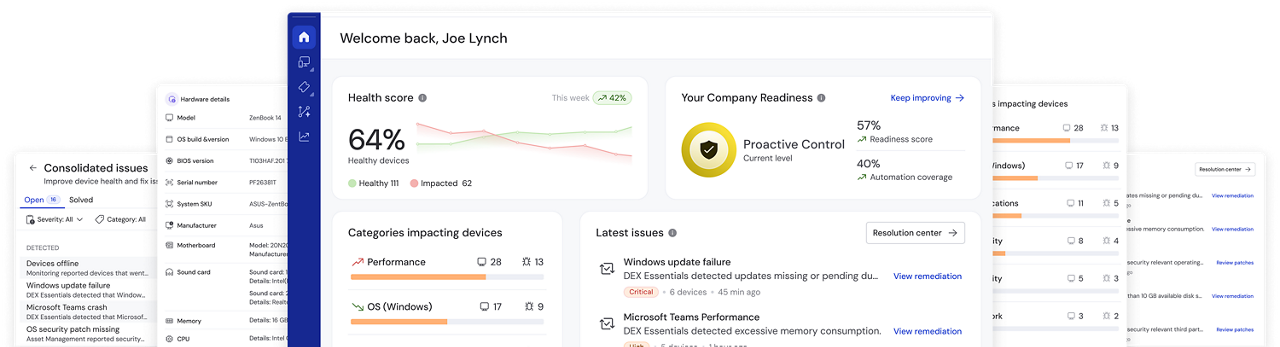
✅ Business impact dashboard, experience metrics, pre-built remediations

AI capabilities

Scripting and workflow support only

Helpdesk efficiency only

Included in all packages, tied to remediation and root cause analysis

IT asset management (ITAM)

Via integrations

Basic

✅ Included

Endpoint protection

Add-on

Via marketplace integrations

Add-on (Malwarebytes)

Backup & recovery

Via integrations

Analytics & reporting

Dashboards and PSA workflows

Operational metrics

DEX-focused (insights, remediation, business impact)

Security & compliance

AES-256, HIPAA & GDPR

AES-256, SSO, MFA, GDPR

AES-256, 2FA, SSO, zero-trust, HIPAA/GDPR/SOC 2

Strengths and weaknesses

Atera vs ConnectWise

Both platforms cover core RMM needs, but each comes with trade-offs worth understanding before committing.

Atera

Atera bundles RMM, PSA, and ticketing into a single platform with a low setup barrier and predictable per-technician pricing. For small teams managing straightforward environments, that combination works.

  • Bundled platform: RMM, PSA, and ticketing in one place
  • Predictable pricing: Per-technician model suits smaller teams
  • Low setup barrier: Accessible without deep technical expertise

  • No native remote support: Relies on Splashtop, AnyDesk, or similar third-party tools
  • Scripting-dependent remediation: Deeper automation requires manual configuration
  • No DEX layer: No visibility into how IT issues affect users
  • AI limited to helpdesk: No connection to remediation or root cause analysis
  • Compliance gap: GDPR only, no HIPAA certification
  • Scaling friction: Per-technician pricing grows costly as teams expand

ConnectWise

ConnectWise covers the RMM fundamentals and fits naturally into MSP workflows within its ecosystem.

Outside that context, the overhead becomes apparent.

  • Core RMM coverage: Solid monitoring, patching, and policy-based automation
  • MSP ecosystem fit: Familiar tooling for teams already in the ConnectWise stack
  • Endpoint-based pricing: Scales by device rather than technician

  • No native remote support: Delivered via ScreenConnect integration
  • Reactive automation: Script- and rule-driven; teams respond to alerts rather than prevent issues
  • No DEX layer: Device-level monitoring only, no user-impact visibility
  • AI limited to scripting: Not tied to remediation or root cause analysis
  • Multi-system workflows: Teams must move between tools to complete core tasks
  • Complex setup: High configuration overhead, especially outside the ConnectWise ecosystem

Which tool fits your IT operations?

Atera and ConnectWise each cover a narrow set of use cases well. But for most IT teams, the gaps outlined above will matter. And neither platform has a credible answer to them.

  • Atera: Where it works and where it stops

    For small teams where PSA functionality matters as much as RMM depth, Atera covers the basics. Per-technician pricing is predictable at smaller scales, and the low setup barrier suits teams without deep technical resources.

    The ceiling is low, though. Proactive remediation, DEX visibility, AI-driven insights, and HIPAA compliance are all out of reach.


  • ConnectWise: Where it works and where it stops

    For MSPs already operating within the ConnectWise ecosystem, the RMM fundamentals and policy-based automation add familiar capability without major disruption. Traditional desktop-heavy environments are where it performs well.

    Outside that context, the limitations compound quickly. Reactive automation, no DEX layer, AI confined to scripting support, and significant setup overhead are hard trade-offs to accept for teams looking to modernize.

  • The case for TeamViewer ONE

    Both platforms were built for a model of IT operations that's increasingly outdated: reactive, fragmented, and focused on device metrics rather than user impact.

    TeamViewer ONE is built around what modern IT teams actually need: a native DEX layer, AI tied directly to remediation and root cause analysis, out-of-the-box automation, and a unified platform that eliminates tool-switching. If moving from reactive to proactive IT operations is the goal, TeamViewer ONE is the more complete answer.

  • See the user behind the device

    Most RMM tools show you what's wrong with a device. TeamViewer ONE shows you who it's affecting and how badly. The native DEX layer connects device telemetry to real user impact, so your team knows where to act first before a slow logon becomes a support ticket.

  • Resolve issues before they become incidents

    Reactive automation keeps IT teams permanently in catch-up mode. TeamViewer ONE identifies patterns and recurring issues in real time, triggering pre-built remediations automatically. No scripting required, no alerts to chase.

  • AI that drives outcomes, not just efficiency

    Where other platforms limit AI to helpdesk or scripting workflows, TeamViewer ONE embeds it across the entire platform. Tia, the TeamViewer Intelligent Agent, accelerates root cause analysis and surfaces patterns across sessions. So your team spends less time diagnosing and more time resolving.

  • One platform, no tool-switching

    Atera and ConnectWise both require moving between systems to complete core IT workflows. TeamViewer ONE unifies remote support, endpoint management, DEX, ITAM, and automation in a single platform. No integrations to maintain, no context switching, no gaps between tools.

Top-rated, award-winning software solution

Ready to move beyond reactive IT?

See how TeamViewer ONE handles the workflows that Atera and ConnectWise can't.

Frequently asked questions (FAQ)

Atera bundles basic RMM with PSA and ticketing for small teams. ConnectWise focuses on script-based automation for established MSPs. Both cover traditional RMM needs but lack DEX, proactive remediation, and AI-driven insights. Areas where TeamViewer ONE sets the standard.

Atera suits small internal IT teams with basic monitoring needs. ConnectWise fits larger operations with established MSP workflows. For teams that need proactive endpoint management, DEX visibility, and unified operations, TeamViewer ONE is the stronger fit.

TeamViewer ONE goes beyond traditional RMM with a native DEX layer, AI tied to remediation and root cause analysis, and a fully unified platform. Trusted by 600,000+ customers worldwide, it delivers proactive IT operations and enterprise-grade security at scale.

Yes. TeamViewer ONE is designed for straightforward deployment alongside existing tools, allowing teams to transition without downtime. Our onboarding support ensures a smooth migration. Speak to an expert to plan the right approach for your environment.