Think of a knowledge worker who experiences 10 separate instances of digital disruption on a typical day. They don't just stop and start their work 10 times. They must continually refocus, remember where they were, and rebuild their train of thought. Even minor disruptions consume far more time and mental energy than the interruption itself suggests.
The numbers back this up. According to a public-sector participant in TeamViewer’s DEX perspective survey, IT-related disruptions cut productivity in their organization by 15% a year. In the same survey, another participant explains “digital friction has a huge impact; all work is done on an employees’ computer so if they can’t access the programs or resources they need, they’d be dead in the water."
The recent impact of digital friction report provides more insights. 48% of respondents said digital friction had delayed critical operations or projects. 42% said it had led directly to revenue loss. Nearly 40% had lost business because of IT dysfunction. And 80% said they lost time to digital friction: an average of 1.3 workdays per employee per month.
Good DEX boosts productivity and cuts costs
The answer is to embed the provision, measurement, and optimization of digital employee experience (DEX) into your IT strategy and day-to-day operations. DEX is the product of how employees interact with your IT systems.
Do your hardware, cloud and SaaS applications, network connectivity, and IT support give staff the seamless support they need to achieve their goals? An excellent digital employee experience makes your systems almost invisible to the user. Systems are simply there when needed, functioning smoothly, without latency, downtime, or unnecessary complexity.
Elements of an outstanding DEX include:
- Experience-level visibility: capturing how devices, applications, systems and your networks perform from an employee's perspective.
- Automated issue resolution: monitoring your IT environment, detecting and resolving issues before they impact user experience and performance.
- Experience measurement: measuring performance against technical benchmarks and how your systems support user goals and priorities.
Your team can already monitor IT performance using existing systems. A DEX platform adds the ability to track and monitor how these systems impact the user experience and productivity. The same platform can intervene automatically, using AI to correct issues before they become bigger problems. For more complex or sensitive issues, it alerts IT specialists, who can then intervene remotely using one-click remote access.
A high-performance DEX environment becomes largely self-healing. And this can benefit your business in ways that are both significant and measurable. At the most basic level, it translates to fewer support tickets, yielding up to a 70% reduction in helpdesk costs.
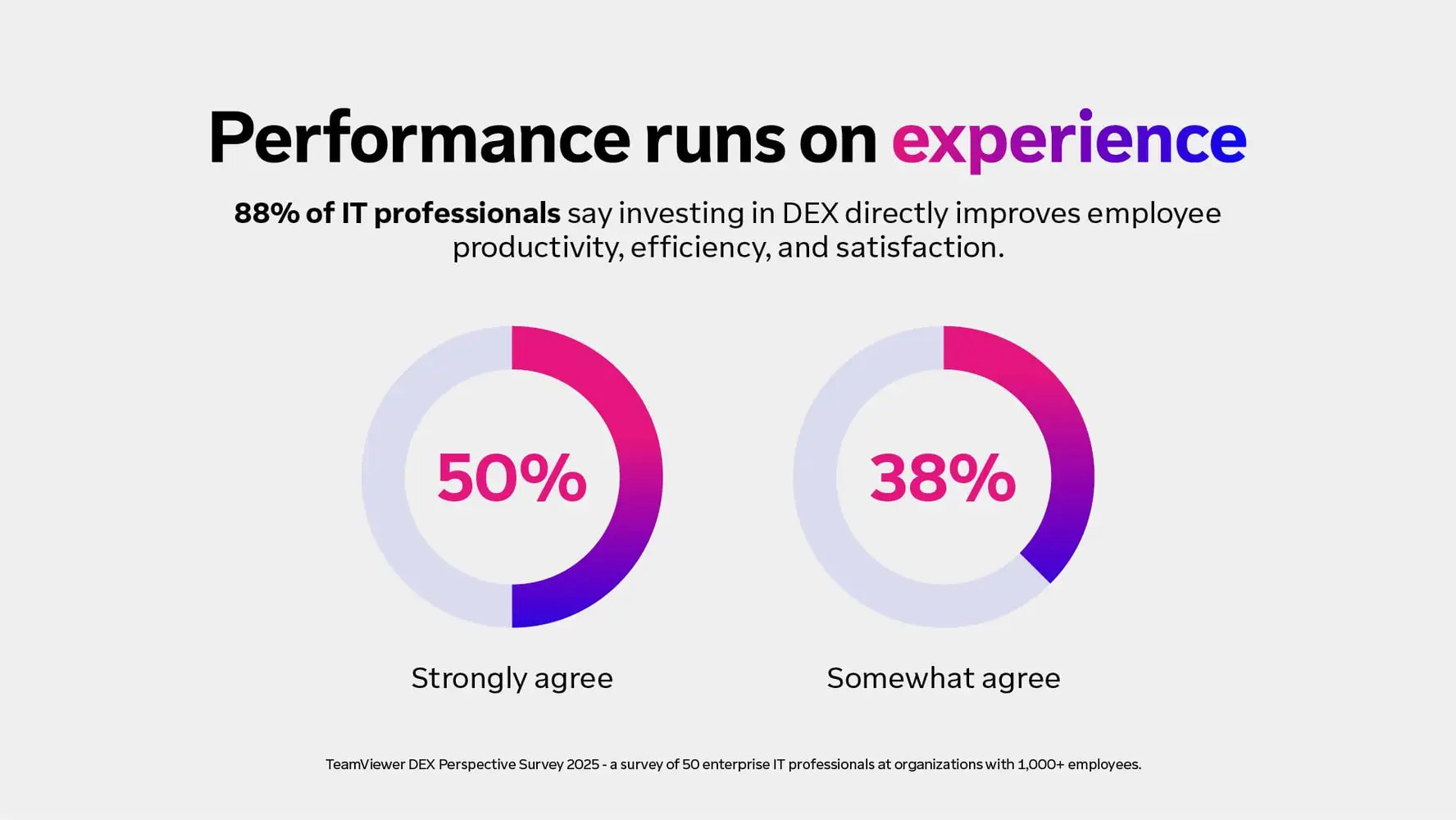
That immediately measurable outcome is just the most obvious result of measuring and optimizing for experience. The greatest gains aren't in systems optimization; they're in what your people achieve with those systems. By closing the gap between how systems function and how well they meet employee needs, you improve employee performance, value creation, business outcomes, and customer experience. With the right approach to DEX, organizations can expect up to 20% higher employee productivity and 40% higher employee satisfaction.