
Work in Progress: 10 Takeaway’s from our conversation with Salesforce’s Alex Wallner
Quick read, Award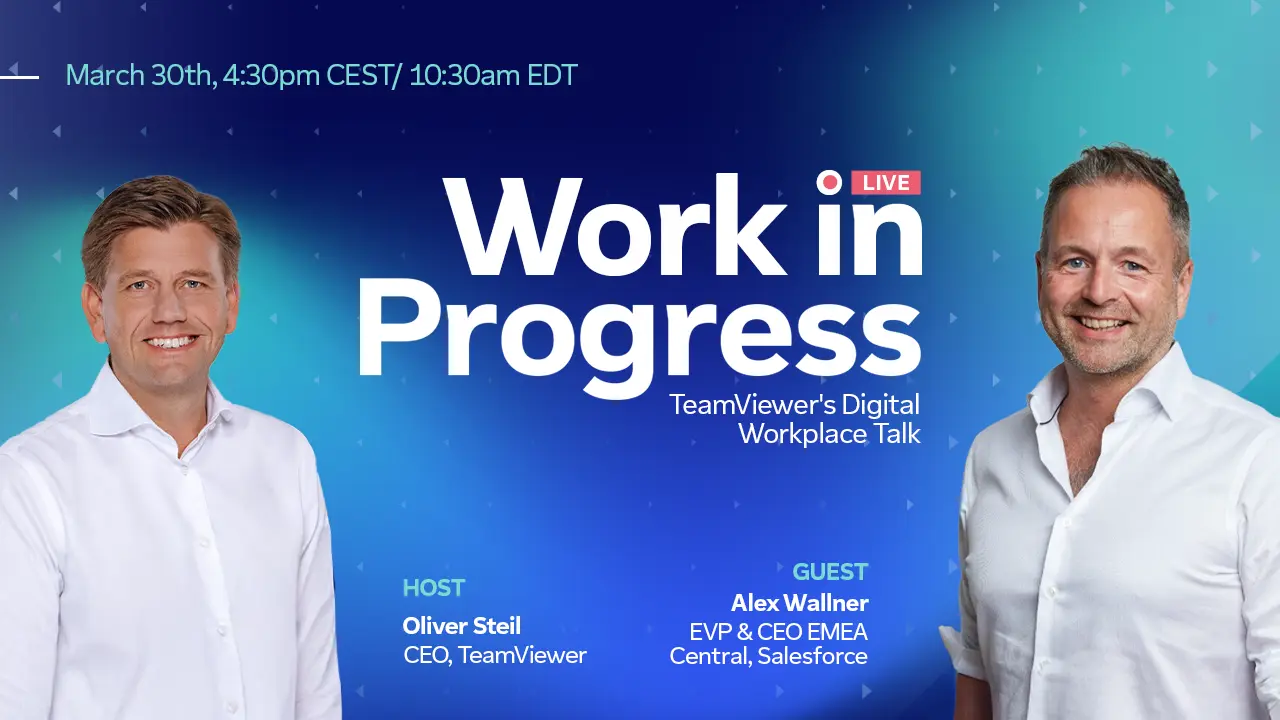
In our latest Work in Progress LinkedIn Live, TeamViewer CEO Oliver Steil sat down with Salesforce’s Alex Wallner, EVP and CEO, EMEA Central, to explore how organizations can move beyond digital transformation hype and unlock real productivity gains with AI.
While companies have invested heavily into AI tools over the last several years, the conversation made one thing clear: many are still struggling to translate that investment into measurable outcomes.
Key themes from the discussion:
The number of enterprise applications continues to grow, not shrink. Add AI into the mix without proper orchestration, and it can make things even more complex for employees.
Organizations are moving away from endless pilots and looking for quick wins — smaller projects that prove value, build momentum, and can scale across the business.
AI isn’t simply improving existing processes. It’s changing how work gets done, requiring employees to shift toward more complex, human-centric tasks while AI handles repetitive work.
With agents and AI capabilities coming from everywhere, the real challenge isn’t who builds them — it’s how companies orchestrate data, workflows, and systems so everything works together.
Smaller businesses often feel overwhelmed by the number of options, while enterprises struggle more with scaling and making sense of everything they’ve already deployed.
In functions like IT service, AI can now handle end-to-end processes — from intake to resolution — if the right guardrails are in place.
Companies still want a human in the loop when it comes to use cases that involve customer interaction, like service, marketing and sales. However, many are becoming more comfortable with internal processes, such as ITSM and employee communication, being handled autonomously.
Many AI and agentic projects stall because companies try to apply them to existing processes instead of embracing a new way of working.
Customers want flexibility, not lock-in. Strong partnerships and open platforms are key to managing the growing complexity of AI-driven environments.
As AI becomes more central to operations, questions around data, governance, and control are moving to the C-level — and becoming a core part of business strategy.
As AI continues to evolve—particularly with the rise of agentic systems—the conversation reinforced a clear takeaway: the organizations that succeed will be those that move beyond tools and truly rethink how work gets done.