The financial implications extend beyond lost productivity. Frustrated employees become disengaged, leading to higher turnover rates and increased recruitment costs. Customer satisfaction drops when internal inefficiencies affect service delivery. Innovation stagnates as teams spend time fighting technology instead of creating value.
Your organization's reputation also takes a hit. As Andrew Hewitt (Vice-President, Strategic Technology) explains: "Employees start speaking out about how difficult it is to work at your company, and eventually, they leave."
Unsurprisingly enough, top performers seek employers who provide modern, efficient tools that enable rather than hinder their work. And that’s where proactive IT management comes in.
Read more: DEX Decoded: Your key to digital workplace excellence
Moving from reactive to proactive IT management
Traditional IT support models wait for problems to surface before acting. This reactive approach allows issues to fester, productivity to suffer, and employees to develop workarounds that mask underlying problems.
Modern organizations need proactive IT management that identifies and resolves issues before they impact employee experience. This shift requires tools that provide continuous visibility into your digital workplace performance.
Proactive monitoring tracks key metrics across your entire technology ecosystem. Instead of waiting for trouble tickets, IT teams receive real-time alerts about performance degradation, application errors, and system instabilities.
This approach delivers multiple benefits. IT teams can address problems during off-hours, minimizing disruption to daily operations. Root causes receive attention rather than just symptoms, preventing recurring issues. Employee satisfaction improves as technology becomes more reliable and responsive.
The transformation from reactive to proactive IT management requires investment in the right tools and mindset changes. However, the return on investment becomes clear through improved productivity, reduced support costs, and enhanced employee satisfaction.
Essential metrics for measuring digital employee experience
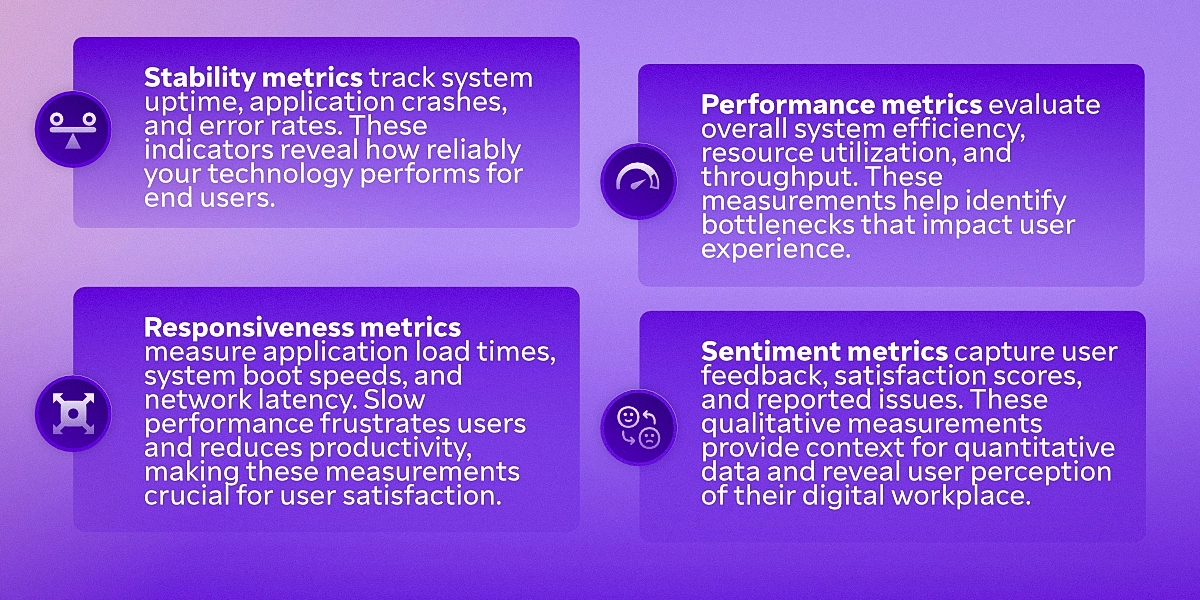
You can't improve what you don't measure. Successful DEX initiatives rely on comprehensive metrics that provide clear insight into user satisfaction and system performance.
Four critical metrics form the foundation of effective DEX measurement: