In recent years, most organizations have invested heavily in the digital workplace. This has meant an increased focus, among other things, on collaboration tools, cloud apps, and endpoint management. But despite all this investment, employees everywhere are still being slowed down by digital friction.
Our recently published Shift left: The IT leader’s digital workplace maturity playbook describes the situation like this: “Most organizations have invested in their digital workplace, but digital friction persists. IT teams are stuck in reactive cycles, resolving issues after they disrupt employee productivity and impact business performance.”
Much deeper than a tooling issue, this disconnect reveals a maturity gap.
The cost of digital friction
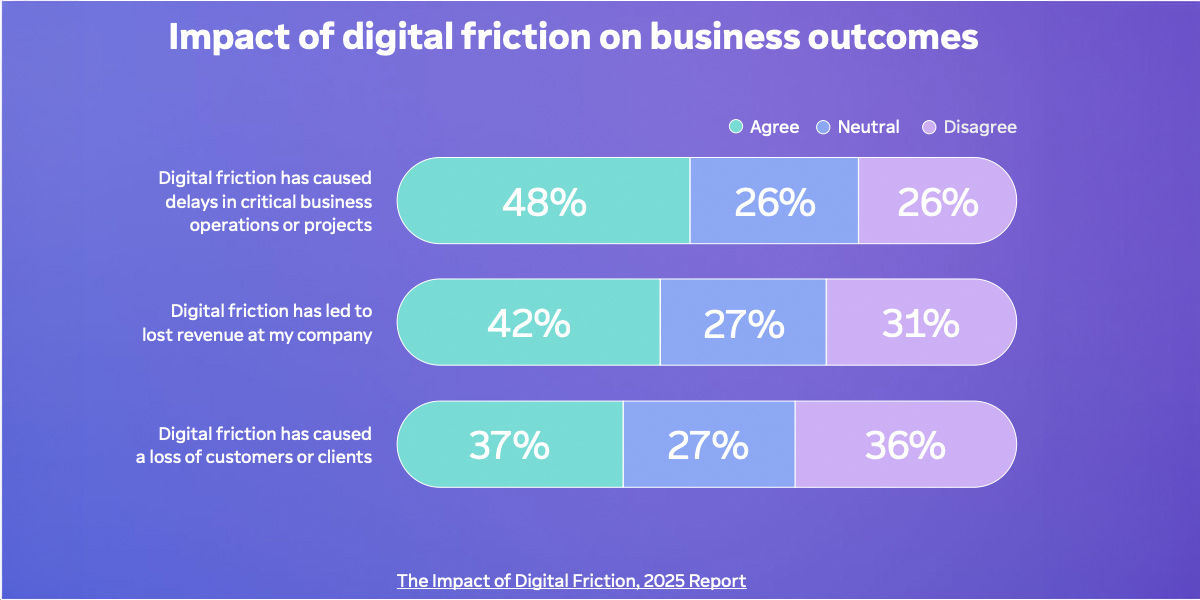
Digital friction has measurable business impact. In fact, according to the playbook’s research:
- Employees lose an average of 1.3 workdays per month to digital friction.
- 48% of organizations report delays in critical operations due to digital friction.
- 42% report direct revenue loss.
- 37% say they’ve lost customers because of IT dysfunction.
And the thing is, digital friction compounds quickly. What starts as a slow device or failed login can quickly ripple across teams, projects, and customer outcomes.
Why reactive IT keeps organizations stuck

When friction appears, most IT teams still respond the same way: they open a ticket, investigate, and (all going well) fix the issue. But all this happens only after disruption has already occurred.
This reactive approach doesn’t tap into the full power of modern IT. One IT leader described it like this:
In our recent survey of 750 IT professionals, the average digital employee experience (DEX) maturity score was 17 out of 30—just 57% of maximum maturity.
The playbook calls this the 57% plateau.
And if they’re wasting time on repetitive issues with no time for truly impactful work, it’s no surprise that organizations are stalling at midlevel maturity.
What “shift left” really means
Instead of trying to work harder or throwing more tools at a situation, shift left is about acting earlier in the lifecycle.
The playbook defines it as: “A service strategy that moves issue detection, diagnosis, and resolution closer to the end-user—reducing reliance on higher-tier support and accelerating time to fix.”
In practical terms, this means:
- Detecting issues before employees feel them
- Automating remediation for common problems
- Preventing repeat incidents instead of reacting to them
The goal here, simply put, is to become faster than friction.
Move from reactive support to predictive operations
The maturity gap facing IT leaders
Even in modern environments, digital workplace maturity can’t get going because visibility, automation, and coordination are limited.
And when technology fails, employees respond in human ways:
- 63% vent to colleagues or managers when technology fails.
- 31% step away from work entirely.
- 9% consider leaving their job.
- 6% report breaking down in tears.
And this, in very human terms, is the maturity gap: the space between digital ambition and digital reality.
This space shows us what needs to be done. As the playbook puts it, after all: “Maturity isn’t defined by what’s been deployed. It’s defined by how effectively it operates.”
A practical path forward: shifting left
The playbook outlines a clear, three phase journey for IT leaders:
Each phase builds toward proactive, and eventually predictive, IT operations.
Why shifting left matters now
Organizations that shift left see benefits that directly address the causes of digital friction:
- Fewer repetitive tickets
- Lower operational cost
- More resilient operations
- Better employee experience
One IT executive put it very simply: “Automation and efficiency improvements make the biggest difference” (VP of Information Technology, IT Services and Consulting).
Start the shift
Digital workplace maturity requires a deliberate shift in how IT operates, from reacting to disruption to preventing it.
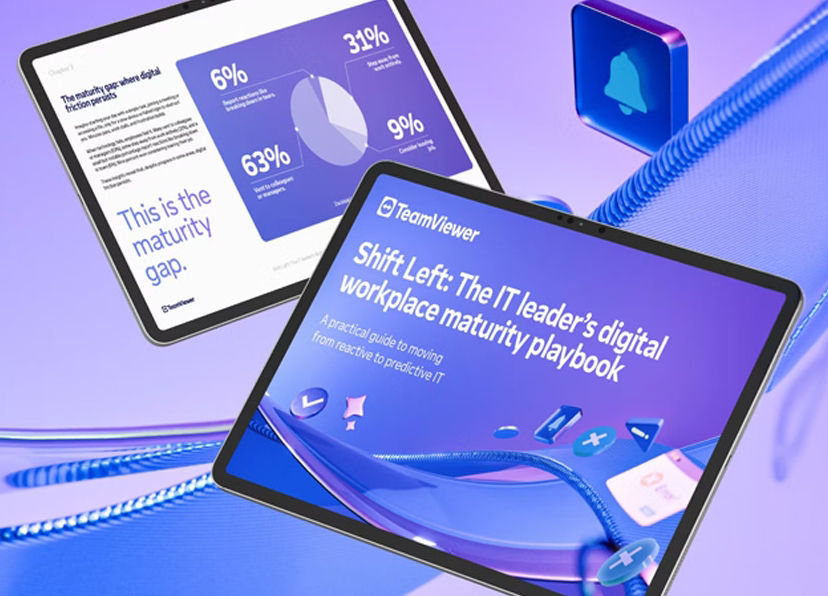
The Shift Left: The IT Leader’s Digital Workplace Maturity Playbook brings the research, real-world insight, and framework together in one practical guide. Now’s the time to start shifting left.

Ready to move from reactive IT to proactive operations?
The Shift Left: The IT Leader’s Digital Workplace Maturity Playbook shows how to close the maturity gap, reduce digital friction, and build a more resilient digital workplace.
Explore more insights
-
Learn how to fix corrupted files on Windows 10 using built-in tools like SFC and DISM. Resolve system crashes and restore stability with our expert guide.
-
Apple has officially released macOS Tahoe, and TeamViewer DEX Client (1E Client), version 25.9, is fully compatible from day one.
-
Empower IT and analytics teams to connect tools securely and uncover deeper business insights with TeamViewer DEX.