If you’re in the manufacturing business, you’ll be well aware of the security threats facing the industry. In fact, according to a recent study from the European Union Agency for Cybersecurity (ENISA), cybercrime is now the main threat to the sector. IBM’s 2026 X-Force Threat Intelligence Index also found that manufacturing remained the most attacked industry globally in 2025, accounting for 27.7% of incidents. IBM reports that the average total cost of a data breach in the industrial sector reached USD 5.56 million in 2024.
This clear need for more control and more security in manufacturing, however, can pull against the needs of actual production. Because above all else, this demands uptime, speed, and minimal disruption, which can be difficult to reconcile with increased control.
For IT teams working in a manufacturing context, then, the question becomes: how do we secure increasingly distributed remote operations while also supporting manufacturers to produce at speed and scale? This is a core problem of today’s manufacturing sector, but it’s possible to navigate it with a remote access solution that’s secure, efficient, and flexible.
Why remote access has become harder to manage in manufacturing

For IT teams working in complex manufacturing environments, the main challenge is the range of assets under their remit. They’re often responsible for top-of-the-range assets across IT and OT, and these somehow have to be reconciled with older legacy systems. Gaining visibility and control over these different, and frequently conflicting components, demands a solution that can work in both registers.
Remote access in manufacturing is also characterized by a lot of third-party and vendor access. For IT teams facilitating remote access and support, this means the environment is often hard to govern, let alone control.
At the same time, the stakes are incredibly high. Because when remote access can’t meet the needs of manufacturing, it means additional downtime. And because manufacturing downtime is incredibly expensive—according to Siemens, unplanned downtime costs the world’s 500 largest manufacturing and industrial companies about USD 1.4 trillion annually—remote troubleshooting delays can quickly turn into commercial issues.
Lastly, there’s the security implications of remote access in manufacturing. In regulated or security-conscious industries in particular, remote access has to meet increasingly stringent demands. This is both in response to more security and compliance regulation, like NIS2, and, as already mentioned, the very real threats facing manufacturing. These threats, in turn, are causing cybersecurity insurers to demand proof from manufacturers that they’re complying with the latest security regulations.
All these factors make the job of IT teams working in manufacturing environments extremely challenging. Because the stakes are high. Not only do they need to keep their complex environment safe and compliant, but they also need to deliver operational continuity and support growth. And this work is often hampered by conflicting needs within manufacturing itself.
Why IT and OT often want different things from remote access

Remote access is a key driver of success across the manufacturing sector, but it comes to IT and OT, there are different needs and priorities at play.
IT teams, on the one hand, prioritize governance, policy enforcement, auditability, and centralized visibility. All these factors enable them to deliver secure and compliant IT at scale.
On the other hand, operational teams want remote access to deliver maximal uptime, fast troubleshooting, ease of use, and compatibility with sensitive or legacy systems.
And the thing is, neither side is wrong. The problem comes from tools and processes that satisfy one side while frustrating the other. In short, having two systems working at odds with each other, creating blind spots, inconsistencies, and unnecessary friction.
What’s needed, instead, is one secure, unified solution that gives IT the visibility they need, while keeping plant teams and vendors productive.
What secure remote access should look like in a manufacturing environment

Fragmentation slows support, creates security gaps, and makes compliance harder to prove. A smarter approach, by contrast, standardizes access in a governed system that supports both operations and security requirements.
In practice, secure remote access should provide:
- One consistent way to connect across sites, systems, and teams
Replacing ad hoc tools and disconnected processes improves visibility, reduces overhead, and makes support easier to scale. - Granular control over access
Permissions should be based on role, system, site, and time window, especially for external vendors and contractors. - Clear visibility into every session
Audit trails, logs, and monitoring help IT trace activity, spot anomalies, and show compliance. - Support for IT and OT environments
Gain access to legacy equipment, segmented networks, human-machine interfaces (HMIs) and programmable logic controllers (PLCs), without installation. - Fast, secure vendor access
Outside experts should be able to step in quickly without relying on unmanaged VPNs, shared logins, or insecure in-house solutions. - Strong security with minimal friction
Plant teams still need to troubleshoot and maintain systems quickly, so governance can't come at the expense of uptime.
Done well, secure remote access creates a more resilient operating model. It reduces tool sprawl, speeds up troubleshooting, improves vendor access control, and gives IT the oversight it needs without making the plant work harder. All the while, meeting security and compliance requirements like NIS2.
5 ways manufacturers can improve remote access without adding friction
As already pointed out, remote access gets messy when every site, team, and vendor uses a different method. The goal, instead, is to simplify access, tighten control, and keep support moving.
What this looks like in practice
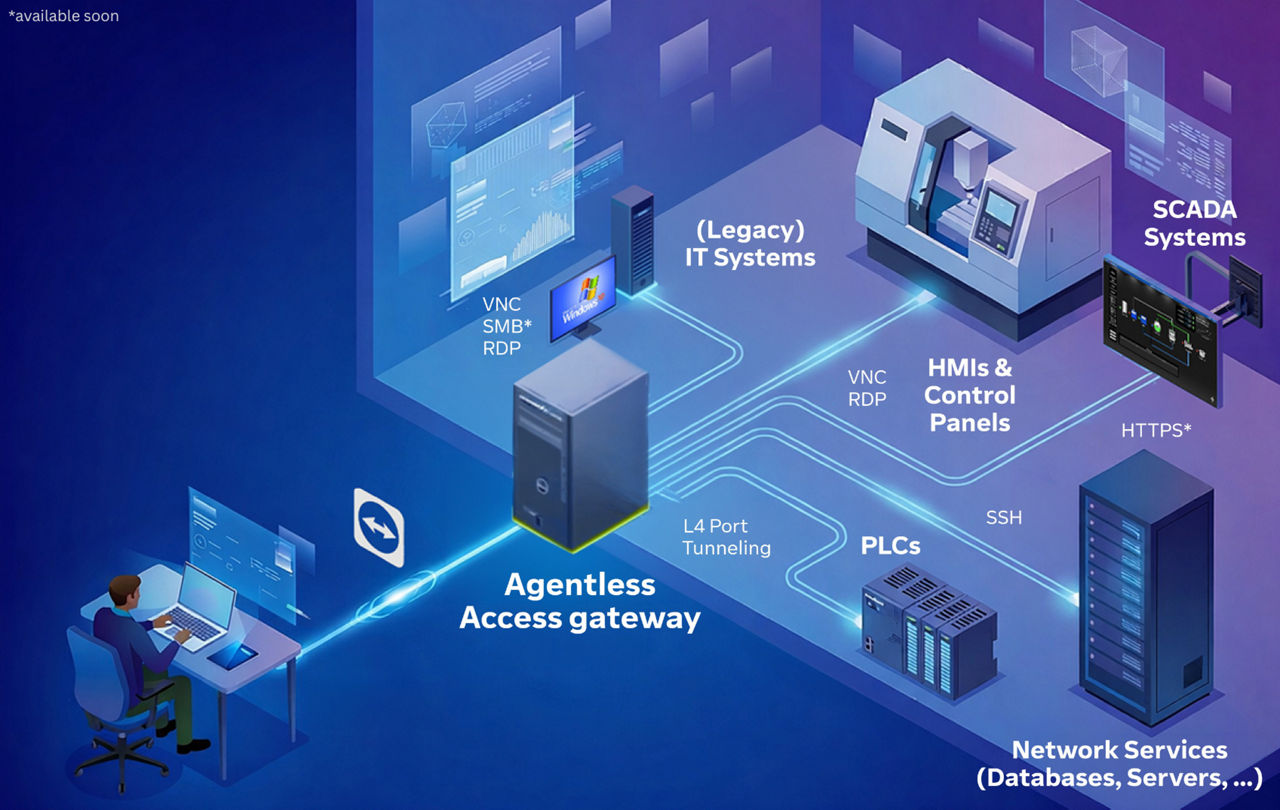
Manufacturers need one secure way to support both corporate IT and shop-floor systems, rather than a patchwork of tools and exceptions. This should support central access management, with permissions tailored by role, site, and system.
For sensitive OT endpoints like PLCs, that kind of setup matters. It lets IT apply controls like single sign-on (SSO), Conditional Access, and audit trails, while keeping support practical for the people and vendors who need to get in quickly.
Let’s say you’re a medical device manufacturer using a VPN-based setup for remote access on your shopfloor. Prompted by new NIS2 compliance regulations, which your current setup doesn’t meet, you decide to consolidate external vendor access to your sensitive production environment.
By switching to TeamViewer Tensor, you get a zero-trust platform for accessing both IT assets and OT systems across your production endpoints. This improves security, supports compliance, and makes the overall environment easier to manage. And all, most crucially, without adding more friction to operations.
No need to choose between security and uptime
At this point it should be clear: a unified remote access platform delivers benefits that go way beyond security or easy deployment. Instead, it can deliver tangible benefits to the operations side, too. And that’s the real takeaway: with the right solution, manufacturers don’t need to choose between stronger governance and smoother operations.
After all, the goal here isn’t forced convergence. We don’t want IT to become more OT, or vice versa. The goal is secure remote operations that respect the unique working principles and priorities of each side. And that’s more than possible with the right solution.

Secure remote operations for manufacturing IT and OT
See how TeamViewer helps manufacturers standardize remote access, strengthen security, and support both corporate IT and the shop floor from one platform.
Explore more insights
-
Learn about the latest updates in our journey to FedRAMP certification and our commitment to secure, compliant endpoint management for federal customers.
-
Let’s explore this evolving tech ecosystem, why it matters, and what it means for your business.
-
New technologies like augmented and virtual reality offer incredible benefits for workplace training.