The traditional IT service model is showing its age. An employee experiences an issue. A ticket is raised. IT investigates. The problem is fixed. Then it happens again.

This break-fix model has become the default operating model for many organizations. But with digital workplaces becoming ever more complex, distributed, and dependent on technology, this reactive approach is difficult to sustain. Employees depend on technology to do their jobs, yet support teams are still spending significant amounts of time resolving issues after disruption has already occurred.
Add to this, the fact that IT teams are spending valuable time solving the same problems repeatedly, leaving less capacity for innovation, strategic projects, and experience improvement.
In a survey of enterprise IT professionals, nearly three-quarters reported that their service desk spends up to half its time dealing with repetitive issues that could be automated, while roughly a quarter said more than half of service desk workload is consumed by repetitive tasks.
The good news? IT leaders know it needs to change, and the shift to more proactive, autonomous IT is already underway.
Reactive IT is holding organizations back
Reactive IT creates challenges for everyone. Employees experience digital friction, productivity slows, and frustration rises. Meanwhile, support teams become overwhelmed by recurring incidents, only becoming aware of issues after they’ve already occurred. IT leaders are then left balancing growing demands, limited resources, and increasingly complex environments.
Even organizations that have invested heavily in digital workplace technologies continue to operate with reactive processes and experience digital disruption. The result is a maturity gap where digital workplace transformation appears complete on paper. But in reality, digital friction continues to disrupt the day-to-day of employees, impacting productivity, experience, and ultimately business performance.
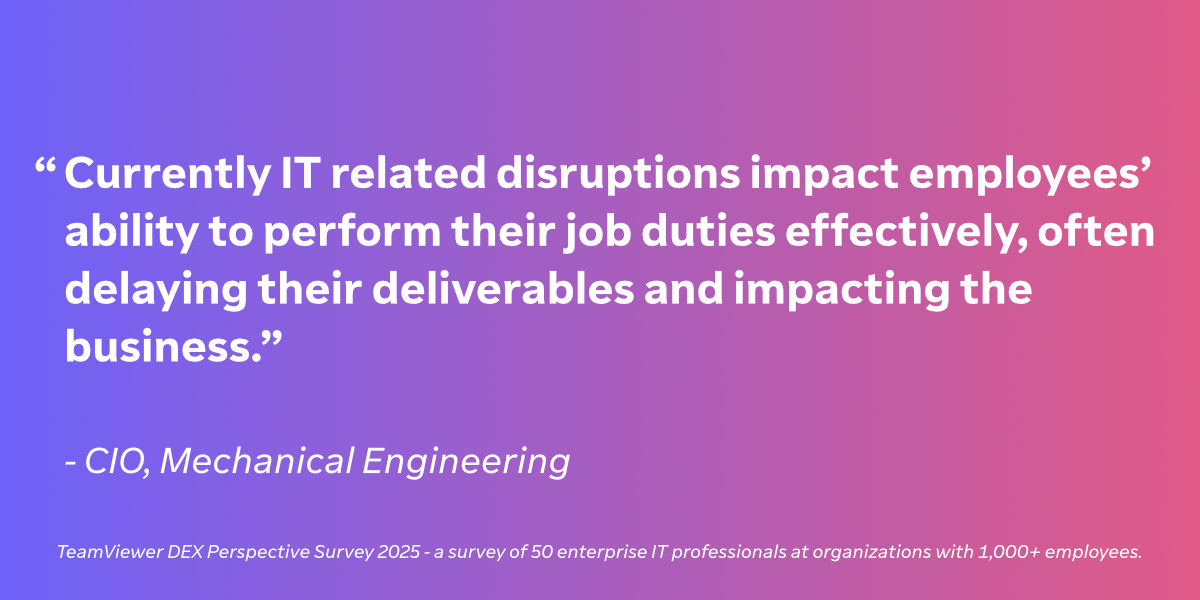
IT teams see this challenge first-hand. According to enterprise IT professionals surveyed, 72% say their service desk spends between 10% and 50% of its time dealing with repetitive issues that could be automated, while 24% report that more than half of service desk workload is spent on repetitive tasks automation could handle.
The challenge is that reactive operating models are designed to resolve problems, not prevent them, creating a cycle where disruption repeatedly returns and consumes valuable IT resources.

Many IT professionals describe this challenge in stark terms. One survey respondent described the "volume of tickets coming in" as far outweighing available staff resources. Another IT manager in government observed, "The number one factor that impacts our organization's average time to resolve IT incidents is staffing. We have a small helpdesk that triage our tickets and send them to support. The goal would be to automate this process as much as possible."
The costs here go beyond operational inefficiency alone. Every recurring ticket represents lost time for employees, additional pressure on support teams, and less capacity for IT to focus on innovation, optimization, and long-term business objectives. This is why the industry's focus is shifting from fixing issues faster to preventing them altogether.
IT is ready to shift left
For many organizations, the next step is proactive IT. And this shift away from firefighting is already underway.
Rather than waiting for employees to report issues, proactive IT focuses on identifying and resolving problems before they create significant disruption. This is central to the concept of shift-left, which aims to move issue detection, remediation, and support closer to the point where problems originate.
Importantly, this isn't simply a vendor's vision of the future. It's what IT professionals themselves are asking for.
80% of IT professionals believe DEX tools will have a moderate to significant impact on helping organizations move from reactive to proactive support, with a further 8% expecting a transformational impact.
This aligns with broader findings from the Path to the Autonomous Workplace report. Among IT decision-makers 41%, say technology issues are handled proactively through early detection and automation. While this does not mean that every IT workflow is proactive today, it suggests that many organizations have established proactive capabilities for certain recurring issues, systems, or use cases.

And this represents a fundamental shift in mindset, where the appetite for change is nearly universal because the benefits are clear. Proactive IT:
- Reduces repetitive incidents
- Minimizes disruption
- Allows support teams to focus on higher-value activities
Success is no longer measured by how quickly IT can close tickets. Increasingly, it is measured by how many tickets never need to be created in the first place. As TeamViewer VP of Strategic Technology Andrew Hewitt explains, "As IT shifts toward autonomy, the goal moves from resolving disruption quickly to preventing it altogether."
Breaking the cycle through automation
If reactive IT is a cycle, automation is one of the most effective ways to break it. Many of the tickets entering service desks today involve issues that are routine, repeatable, and well understood. These are the ideal candidates for automation.
The most effective IT teams are identifying these recurring issues, understanding their root causes, and automating remediation wherever possible. The result is fewer tickets, less manual intervention, and more capacity for these teams.
In Shift Left: The IT leader’s digital workplace maturity playbook, this is described as moving from "responding to disruption" toward "preventing disruption." Rather than manually troubleshooting known issues every time they occur, organizations automate common fixes, establish experience benchmarks, and use data to identify patterns before they escalate.
The objective is simple: Fix once. Fix forever.
By reducing repetitive tickets and automating known issues, IT teams can focus on strategic activities that improve digital employee experience, strengthen resilience, and support broader business goals.
The role of AI
It's clear that IT professionals consistently see AI as an enabler of proactive and autonomous operations. They envision AI helping detect emerging problems, surface patterns, automate routine remediation, and accelerate support workflows. As one IT infrastructure director explains, "AI should make things smoother by spotting problems early, fixing simple ones automatically, and helping IT respond faster when something breaks."

This reflects the evolution outlined in the Path to the Autonomous Workplace report:
- Reactive IT fixes issues after disruption occurs.
- Proactive IT detects and resolves issues earlier through AI-powered monitoring and automation.
- Predictive IT identifies risks with AI before an employee's workflow is affected.
- Autonomous IT enables AI agents to detect and resolve issues with progressively less direct human intervention.
IT professionals do not see AI as a replacement for IT teams. Instead, they see it as a means to eliminate repetitive tasks, improve operational efficiency, and free skilled professionals to focus on security, innovation, governance, and strategic work.

The future of IT isn’t humans versus AI. It’s humans supported by AI.
The path to autonomous IT
IT is ready to leave firefighting and reactive IT behind, and the autonomous digital workplace is where they’re heading. However, the journey toward autonomous IT won't happen overnight. Most organizations are still building the necessary foundations required to support greater autonomy, including visibility, connected systems, governance frameworks, and employee trust.
What makes autonomous IT compelling is the value of what it delivers:
- Fewer disruptions
- Fewer repetitive tickets
- Faster resolution
- Reduced manual effort
- Better digital employee experiences
- More time for strategic work
The autonomous digital workplace ultimately represents the next stage in IT's evolution. Instead of spending every day reacting to the same issues, teams can focus on creating environments where employees remain productive, engaged, and free from digital friction – ultimately serving the business as a whole. And judging by the research, IT professionals are more than ready for that future.

Want to learn more about the future of autonomous IT?
Download the Path to the Autonomous Digital Workplace report to explore how organizations are moving beyond automation toward proactive, predictive, and autonomous ways of working.
Explore more insights
-
Learn how to change your WiFi channel to boost speed, reduce congestion, and improve reliability on 2.4 GHz and 5 GHz networks.
-
In recent years, IT security has grown much more complex. Here's some unmissable features to keep your IT fleet safe.
-
Remote access doesn’t have to be a risk. See how TeamViewer Tensor builds security into every connection with encryption, zero trust, conditional access, and more.