

13 best MSP software platforms for 2026
It's 2 a.m. and your phone buzzes. A client's server is down, and their business continuity is on the line. Three hours later, a different client reports their backup failed overnight. By noon, you're fielding support tickets from six companies while trying to deploy security patches across 400 client endpoints. Your client roster has doubled, but your team hasn't.
You need MSP software that fits your operational, security, and scalability requirements.
This guide compares 13 leading MSP software platforms for 2026, evaluating each one on the criteria that actually decide a shortlist: pricing model, native remote support, automation depth, digital employee experience (DEX), AI, device coverage, and security.
What is remote access software and what to look for?
MSP software is a unified platform that helps managed service providers (MSPs) remotely monitor, manage, and support client IT infrastructures. It combines remote monitoring and management (RMM), professional services automation (PSA), remote access, and help desk capabilities into one system.
The shift to remote work has made these tools essential. MSPs now support employees working from home offices, coffee shops, and distributed locations worldwide. Teams that once managed on-site infrastructures now handle diverse, geographically scattered environments. That makes comprehensive MSP software critical for staying competitive and meeting client expectations.
These platforms let MSPs track device health, deploy patches, automate maintenance tasks, and resolve support tickets without being physically present. The goal is simple: improve operational efficiency while reducing manual work and boosting profitability.
What to look for in MSP tools
Choosing the right MSP software means evaluating a handful of key features that directly shape your service delivery and your margins.
Features
Remote monitoring and management (RMM) is the foundation of any MSP platform. Look for real-time monitoring of servers, workstations, network devices, and endpoints, with customizable alerting that flags issues before they reach users.
Strong RMM capabilities include:
- Automated patch management
- System health tracking
- Performance metrics
- Ability to execute scripts remotely
The best MSP software platforms support unattended access, so you can fix problems outside business hours without client intervention.
Security is the baseline expectation for every MSP client. Your software should provide end-to-end encryption, two-factor authentication (2FA), and role-based access controls to help protect sensitive data.
Compliance features matter too, especially for MSPs serving healthcare, finance, or legal sectors. Assess whether the provider offers features, contractual commitments, and independent reports relevant to applicable requirements, such as HIPAA, GDPR, and SOC 2, together with appropriate audit logging. Conditional access policies add another layer by restricting connections based on user location, device status, or time of day.
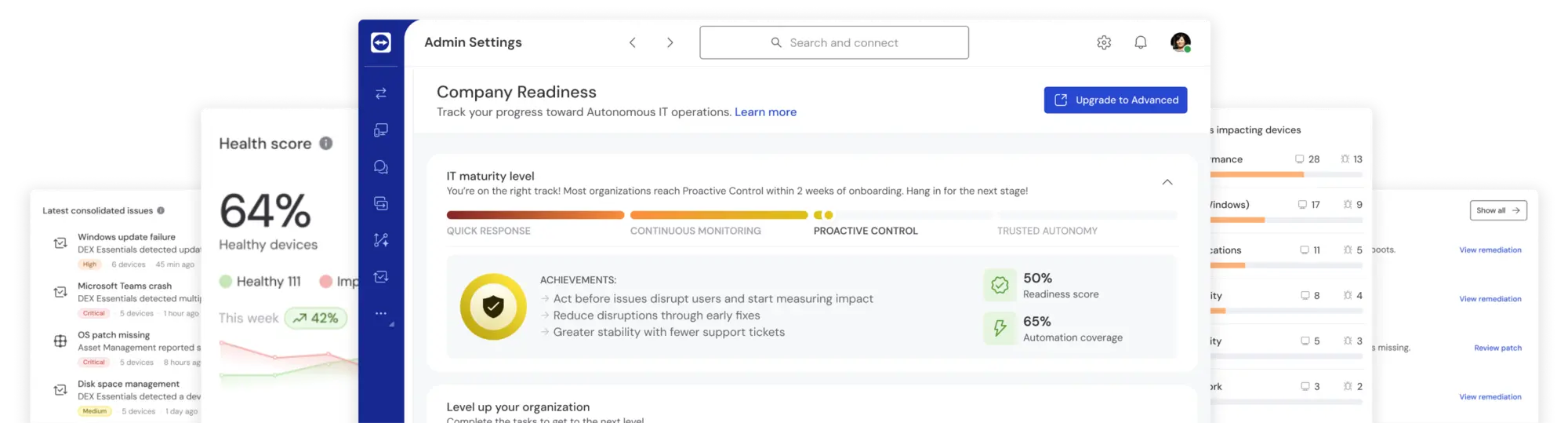
Device monitoring tells you a laptop is running slowly. DEX tells you which employee is affected, how often it's happening, and whether it's costing them productive time. That distinction matters more than it sounds, because most RMM platforms stop at the device and never connect the dots to the person using it.
Look for platforms that combine endpoint telemetry with real experience signals, things like logon times, app responsiveness, and recurring friction points, then translate that into a clear picture of business impact. The strongest DEX capabilities let you catch and fix problems before an employee notices them, which means fewer tickets and a service story you can actually bring to a client renewal conversation.
Your MSP software should connect with the tools you already use. Native integrations with PSA platforms, ticketing systems like ServiceNow and Jira, and CRM solutions like Salesforce remove manual data entry, centralize management, and help ensure accurate billing across every client contract.
API support covers the custom integrations that off-the-shelf connectors miss. The fewer tools your team jumps between, the faster they work.
You can't manage what you can't see. Look for platforms that automatically discover and inventory hardware and software across every client environment, then keep that inventory current as devices, licenses, and warranties change.
Strong ITAM capabilities include tracking device lifecycle from deployment to retirement, flagging software nearing end of license or end of support, and surfacing warranty status before a hardware failure catches you off guard. This matters for more than housekeeping. Accurate asset data feeds directly into patch prioritization, security audits, and the budget conversations you have with clients about refresh cycles.
Automation changes how MSPs operate by removing repetitive manual work. Depending on its configuration and licensed features, a platform may help automate routine maintenance, backup scheduling, software deployment, and alert responses.
AI takes this further. Predictive analytics identify patterns and prevent issues before they surface. Session insights can document support interactions automatically, analyze recurring problems, and suggest proven fixes. This may reduce administrative work and support more consistent service delivery.
Pay close attention to where AI sits in the product. In several platforms, AI is bolted onto scripting or patching alone. The value for an MSP comes when AI connects to remediation and to what your clients' employees actually experience.
MSPs need centralized management to segregate and manage multiple client environments without mixing client data or configurations. Look for platforms that support multi-tenancy with clear client separation, customizable branding, and individual security policies.
The ability to switch between client dashboards quickly, generate per-client reports, and apply different service levels is what makes scaling your MSP business manageable.
Comparison
Top 13 MSP software tools
Data as of September 2026, subject to change.
Here's how the leading MSP platforms compare in 2026. The criteria below are the ones that separate a genuine shortlist contender from a tool that will slow you down at scale.
TeamViewer ONE | NinjaOne | Kaseya VSA | ConnectWise RMM | Atera | N-able N-central | SuperOps | Datto RMM | Syncro | ManageEngine RMM Central | LogMeIn Resolve | Naverisk | Pulseway | |
|---|---|---|---|---|---|---|---|---|---|---|---|---|---|
Pricing model | Endpoint-based | Per device, quote-based | Endpoint-based, quote | Endpoint-based | Per technician | Quote, per device | Per technician | Quote-based, contract minimums | Per user | Per device and technician | Per seat | Per device or seat | Per endpoint, tiered |
Platform architecture | Unified, cloud-native | Cloud-native | Ecosystem (VSA, Datto, IT Glue) | Asio, multi-product | Cloud RMM/PSA with marketplace add-ons | Ecoverse ecosystem, multi-product | Cloud-native RMM/PSA | Cloud RMM, Kaseya portfolio | Combined RMM/PSA | Modular suite | Unified RMM, remote access, MDM | All-in-one, cloud or self-hosted | Cloud RMM, mobile-first console |
Multi-tenancy | Native, per-client policies, branding, and SSO/2FA enforcement | Native, per-client branding and dashboards | Multi-client segregation via VSA workspaces | Native, built for the ConnectWise partner ecosystem | Multi-client dashboards under per-technician model | Native, granular per-client permissions | Native, per-client dashboards | Native, via Kaseya portfolio account structure | Native, per-client accounts | Multi-client via modular console, less unified | Multi-client account and site structure | Native, client-based structure | Multi-client via groups and sites |
Native remote support | Native, built in | Native, built in | Via Live Connect | Via ScreenConnect | Via AnyDesk, Splashtop, or third party | Via Take Control module | Bundled Splashtop on unified tiers | Web Remote | Built in (Splashtop bundled) | Separate module | Native, built in | Via bundled third-party remote control | Built in for Windows and macOS |
Endpoint monitoring & patching | Included (Advanced) | Yes | Core feature | Yes | Yes | Yes, gated by tier | Yes | Yes | Yes | Via Endpoint Central | Yes | Yes | Yes |
Automation & remediation | No-code, insight-driven, real time | Script-based | Script and policy | Script and policy | Codeless via AI agents | Script and policy, alert-triggered | Script-based with AI assist | Script-based | Script-based | Native automation, module-dependent | Codeless | Script-based | Script-based |
DEX | Included platform-wide | None | None | None | None | None native | None | None | None | DEX Manager Plus add-on | None | None | None |
AI capabilities | Tia troubleshooting, Session Insights, AI-assisted scripting, in every package | Patch Intelligence AI | Kaseya Intelligence, ticket triage | AI-assisted scripting | AI Copilot and end-user self-service agent | N-zo assistant | Monica AI for alerts and scripts | Cooper Copilot (mainly in Autotask PSA) | Limited | Distributed across products | AI Virtual Technician, AI scripting, session notes | Limited to ticket/email sentiment scoring | Limited |
ITAM | Included (Advanced) | Yes | Via ecosystem | Via integrations | Basic | Yes | Basic | Basic | Basic | Yes | Yes | Yes | Yes |
Endpoint protection | Add-on (Malwarebytes) | Third-party EDR integrations | Add-on integrations | Add-on | Marketplace | AV/EDR add-ons | Marketplace | Add-on | Marketplace | Native EDR via Endpoint Central | Antivirus oversight | Via integrations | Add-on (Bitdefender, Webroot) |
Backup & recovery | Add-on | Add-on (Dropsuite) | Via integrations | Yes | Via integrations | Cove, sold separately | Via integrations | Integrated | Via integrations | Yes | None | Included data protection | Basic add-on |
Analytics & reporting | DEX dashboards, business impact | Limited customization | Dashboards, PSA workflows | Dashboards, third-party reporting | Mostly operational | Limited | Limited | Standard dashboards | Limited | Gated by tier | Fleet reporting, session summaries | Basic | Standard reports |
PSA/ticketing integrations | Native integrations with ServiceNow, Jira, Salesforce, Microsoft 365, Intune, and 25+ platforms | Built-in ticketing; full PSA needs a separate tool | Integrates with Kaseya BMS, IT Glue, and third-party PSA | Deep integration with ConnectWise PSA/Manage | Built-in PSA: ticketing, billing, and time tracking | Via third-party PSA integrations | Built-in PSA, unified with RMM in one codebase | Integrates with Autotask PSA and the Kaseya portfolio | Built-in PSA: ticketing and billing combined with RMM | Integrates with ManageEngine ServiceDesk Plus and third-party PSA | Built-in ticketing; connects to external PSA via integrations | Built-in PSA and ticketing combined with RMM | Basic built-in service desk; deeper PSA needs a separate tool |
Security & compliance | AES-256, zero trust, Conditional Access, SSO, SOC 2/3, HIPAA, GDPR, ISO 27001 | AES-256, SOC 2 Type II, HIPAA, GDPR | 2FA, encryption, HIPAA, GDPR | 2FA, encryption, HIPAA, GDPR | 2FA, encryption, HIPAA, GDPR, SOC 2 | AES-256, SOC 2, HIPAA, GDPR | 2FA, encryption, SOC 2, GDPR | 2FA, encryption, HIPAA, GDPR | 2FA, encryption, HIPAA, GDPR | 2FA, encryption, HIPAA, GDPR | Zero trust, encryption, 2FA | 2FA, encryption, GDPR | 2FA, encryption, GDPR |
Devices supported | Windows, macOS, Linux, Android, iOS, ChromeOS, Raspberry Pi, embedded, IoT | Windows, macOS, Linux, Android, iOS | Windows, macOS, Linux | Windows, macOS, Linux | Windows, macOS, Linux | Windows, macOS, Linux, iOS, Android | Windows-first, macOS and Linux lighter | Windows, macOS, Linux | Windows, macOS | Windows, macOS, Linux | Windows, macOS, iOS, Android, ChromeOS | Windows, macOS, Linux | Windows, macOS, limited Linux, mobile MDM |
Support & SLA | 30+ languages, enterprise SLAs, dedicated success managers | Tiered vendor support | Tiered, multi-year contracts common | Partner and vendor support | Included, scales with technician count | Tiered vendor support | Vendor support, smaller team | Kaseya support, paid onboarding | Included, small-team focus | Tiered, config-heavy setup | Tiered support | 24/7 global support | Tiered support |
How to choose the best MSP management software
Selecting the best MSP software means finding the platform that helps you optimize service delivery while balancing your current needs with future growth plans. Consider the following steps.
Why businesses choose TeamViewer over other MSP providers
TeamViewer ONE stands out in a crowded market by solving the problems remote-first MSPs actually face day to day.
Benefits
This is where TeamViewer ONE pulls furthest ahead of competitors. Powered by Tia, TeamViewer's AI agent, Session Insights automatically summarizes every support session and surfaces the remediation steps that actually worked, then turns those proven fixes into reusable scripts technicians can apply the next time the same issue shows up, on any client's devices.
This means less time re-diagnosing the same recurring issue across different client environments, faster resolution for new technicians who don't yet have years of tribal knowledge, and a growing library of institutional fixes that gets more valuable with every session logged.
Layered on top, AI-driven predictive monitoring and DEX capabilities flag problems before they generate a ticket, shifting MSPs from reactive firefighting to proactive maintenance, which directly reduces ticket volume and improves client satisfaction scores.
TeamViewer works seamlessly across Windows, macOS, Linux, Android, iOS, Raspberry Pi, and IoT devices. This universal compatibility means you can support any client environment without worrying about platform limitations.
Other competitors offer less seamless IoT coverage or might be able to support desktop-devices-only environments, forcing MSPs to use multiple tools or leave certain devices unmanaged. TeamViewer's comprehensive device support simplifies your tech stack and ensures consistent service delivery.
TeamViewer has proven itself in demanding enterprise environments. With over 620,000 customers worldwide, TeamViewer has a track record of delivering premium solutions for business demands. This global trust extends to MSPs managing critical infrastructure where reducing downtime is essential and outages aren't acceptable.
The platform's reliability track record means fewer support escalations, consistent performance, and the confidence that your remote access tool won't become a liability during critical support situations.
TeamViewer ONE connects natively with the PSA, ITSM, and CRM platforms you already run, including ServiceNow, Jira, Salesforce, Microsoft 365, and Microsoft Intune. Context from AI-summarized sessions carries straight into your service desk instead of getting lost between tools.
Through the TeamUp MSP Partner Program, you also get service development frameworks, readiness assessments, enhanced support SLAs, and go-to-market tools. Support is available in more than 30 languages, with enterprise SLAs and dedicated success managers behind it.
Most RMM tools show you device metrics. TeamViewer ONE shows you who is losing time, how often, and what to fix first. Telemetry connects directly to user impact, and no-code remediations resolve recurring problems automatically. New automations can be built in plain language in seconds, with no scripting specialist required.
Automated patch and compliance checks keep every device in policy without a manual pass, so configuration drift gets caught and corrected instead of discovered during an audit.
Comprehensive security measures are non-negotiable for MSPs. TeamViewer provides 256-bit AES encryption, conditional access controls, comprehensive audit logs, and enforced two-factor authentication as standard features.
The platform maintains HIPAA, GDPR, and SOC 2/3 compliance certifications, giving you the documentation needed for audits and client security reviews. TeamViewer offers stronger HIPAA compliance than competitors, like Kaseya VSA. This security-first approach protects both your MSP and your clients from breaches and compliance violations.
TeamViewer ONE offers faster setup and a more intuitive interface than heavyweight platforms like ConnectWise or N-central. Less time learning the tool means more time solving client problems.
A streamlined interface reduces training costs and speeds up onboarding for new technicians, which matters when your team is growing and your clients aren't waiting.
Real-world results: How Yammm boosted IT support efficiency by 25%
To see these capabilities in action, look at Yammm, a 15-person managed services provider based in Houston that supports clients across Houston, Chicago, Oklahoma City, and beyond.
The challenge
Documentation was Yammm's biggest bottleneck. With a small team supporting multiple clients, recurring issues often went unresolved simply because nobody had a consistent record of what fixed them before. Knowledge lived in individual technicians' heads rather than anywhere the whole team could access it, which slowed onboarding and made service quality dependent on which tech picked up the ticket.
The solution
Yammm rolled out TeamViewer AI and made Session Insights mandatory across the team. Every support session is now automatically summarized, building a shared knowledge base that's available to every technician from day one, including brand-new hires supporting clients with niche, unfamiliar setups.
The results
- 25% faster resolution on recurring issues
- 5 to 10 minutes saved per client interaction on documentation alone
- 25 to 50 hours saved per month on manual documentation, across a 15-person team
- Stronger audit readiness, thanks to consistent, automatically generated session records
- Consistent service quality regardless of which technician handles a client's issue
Yammm's Co-President Michael Welter noted the knowledge base has cut mentorship time and let new hires support complex clients almost immediately. The team is now exploring using the same AI-driven insights for security anomaly detection and compliance auditing.
Why this matters for MSPs
Yammm's results are a direct illustration of the Session Insights advantage covered above: it's not just a convenience feature, it measurably shrinks the time technicians spend on documentation and repeat troubleshooting, while making service quality less dependent on any one person's tenure or memory. For an MSP juggling multiple client accounts with a lean team, that combination of hours saved and consistency gained goes straight to margin.

Final thoughts
Remote work has permanently changed IT support expectations. MSPs need platforms that handle distributed workforces, diverse device types, and geographically scattered infrastructure without compromising security or performance. The tools you choose today will determine whether you can scale efficiently or remain stuck in reactive support mode.
TeamViewer delivers the security, device coverage, and automation capabilities that modern MSPs need to stay competitive. With proven reliability, intuitive operation, and AI-powered insights, it's built for the remote-first world your clients operate in.
Ready to see how TeamViewer ONE can help your MSP deliver better service? Talk to an expert and experience the difference that comprehensive remote access and monitoring capabilities make for your business.