September 2026 brought several milestones across TeamViewer’s AI strategy, product portfolio, partner ecosystem and customer success. Highlights included the expansion of Tia from AI-powered guidance to governed action, new TeamViewer ONE capabilities designed to turn proven fixes into repeatable automations, recognition from Salesforce, and measurable results from AkzoNobel’s use of TeamViewer DEX.
Here’s a look at some of the month’s biggest stories.
TeamViewer advances AI-powered IT support from guidance to governed action
September marked another step toward more autonomous IT with the launch of Tia Troubleshooting.
The expanded TeamViewer Intelligent Agent can now support an IT issue from investigation through resolution during a remote support session. Tia analyzes the problem, identifies a likely root cause, proposes a fix, carries out approved actions, then validates resolution. Importantly, IT experts remain in control: actions that make changes require approval and are logged for visibility and auditing.
The launch generated media attention around TeamViewer’s approach to governed autonomy. Compare the Cloud noted that Tia’s human approval gate is “by design rather than a limitation,” connecting the approach to TeamViewer research showing that employees want greater oversight as AI becomes more autonomous. The article also highlighted different benefits across the IT service desk, including a more structured troubleshooting process for less experienced staff, faster investigation for senior engineers and potentially more issues resolved on first contact for employees.
IT Brief similarly focused on the shift from recommendations to action while emphasizing that the IT professional remains responsible for authorizing changes. Together, the coverage reinforced a central idea behind Tia Troubleshooting: increasing what AI can do without requiring organizations to surrender control.
Later in the month, we went deeper with Senior Vice President Product Management Sebastian Schrötel in a Newsroom Q&A on what Tia Troubleshooting means for IT support. Sebastian explained how Tia can build on device context, proven fixes and knowledge from previous support cases, creating a flywheel in which each issue resolved can help make future IT support faster and increasingly automated.
That momentum is already visible in how customers are using TeamViewer AI. In September, TeamViewer reported that the number of customers using its AI capabilities grew 9.1-fold in twelve months, from 6,921 to 62,953. Session Insights also passed four million AI-generated remote support summaries, compared with roughly 22,000 a year earlier. Read more about the growth of TeamViewer AI adoption.
September closed with another step toward more autonomous IT operations. New Automations and an enhanced Resolution Center in TeamViewer ONE help IT teams turn successful fixes for recurring endpoint problems into reusable, policy-driven workflows. Instead of repeatedly investigating and resolving the same issue, teams can capture what worked and apply it consistently the next time the problem occurs. The broader goal is to connect troubleshooting, knowledge capture and automated remediation, so organizations build on previous resolutions rather than starting from scratch.
TeamViewer VP of Strategic Technology Andrew Hewitt contributed to the conversation with an article in The AI Journal, in which he argues that wider adoption of autonomous AI will depend on transparency, explainability and giving people clear boundaries around when AI can act independently. As he writes, “The trust built today will shape how quickly that changes.”

Oliver Steil: Europe needs to turn AI investment into real economic value
At the European Conference of German Business 2026 in Lisbon, TeamViewer CEO Oliver Steil joined a panel exploring what Europe needs to translate its strengths in research, industry and technology into greater AI adoption, productivity and competitiveness.
Oliver explained that Europe’s challenge is not simply developing AI technology, but putting it to work at scale. That means focusing on meaningful use cases tied to measurable outcomes, embedding AI into existing workflows and ensuring investments in AI infrastructure ultimately translate into products, productivity and intellectual property.
Oliver also highlighted Europe’s opportunity at the application layer, where AI connects with devices, machines, factories and frontline workers. Europe’s industrial expertise and engineering capabilities could provide an advantage in areas such as maintenance, IT operations and technical service — particularly when paired with strong governance, transparency and customer control. Read more of his takeaways from the event here.

TeamViewer named a Rising Star in Salesforce’s Partner of the Year Awards
TeamViewer was also recognized in Salesforce’s 2027 Partner of the Year Awards, receiving the Rising Star award for ISV Partners.
The recognition comes as TeamViewer continues to bring its remote connectivity and endpoint management capabilities into the Salesforce ecosystem, including through AgentExchange. Together, the technologies can support a shift from reactive IT support toward more proactive and automated resolution while preserving the ability for human experts to step in when needed.
Alfredo Patron, Executive Vice President, Global Partner Ecosystem & Channels at TeamViewer says the recognition reflects TeamViewer's efforts to combine AI-driven workflows with automated endpoint management and secure remote support. That work allows TeamViewer to “help customers resolve more IT issues proactively while giving their teams the ability to step in when human expertise is needed.”
AkzoNobel cuts IT tickets by more than 40% with TeamViewer DEX
A new AkzoNobel customer success story shows what proactive IT can deliver at enterprise scale.
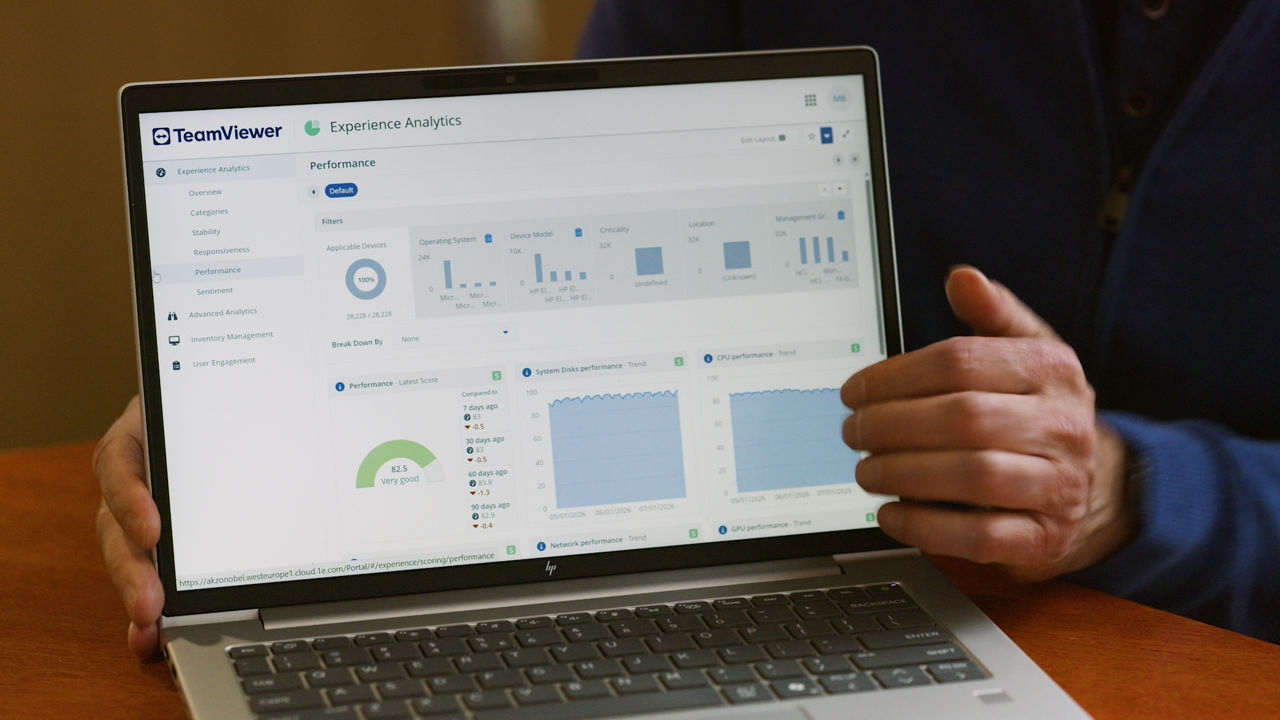
AkzoNobel uses TeamViewer DEX to monitor and support more than 25,000 devices across 995 locations, giving its workplace team greater visibility into device health and helping it identify and resolve problems before they disrupt employees. The platform also connects with tools already used by AkzoNobel, including ServiceNow and its employee chatbot, Xara.
The results are significant. By connecting Xara with TeamViewer DEX, AkzoNobel has cut IT tickets by more than 40% and saved more than 52,000 minutes in a single quarter. The team also used DEX to remotely make a connectivity change across approximately 25,000 devices with a 97% success rate — work that would otherwise have required hands-on support and an estimated 253 days of employee and field service time.
The story demonstrates how small amounts of digital friction add up across a global device estate, and how visibility, automation and proactive remediation can turn those lost minutes back into meaningful time for both employees and IT teams.
Looking ahead
September’s stories shared a common theme of moving from potential to practical impact. From AI that can take approved action and learn from previous resolutions, to measurable reductions in IT tickets and stronger technology partnerships, TeamViewer continues to build toward a digital workplace where more issues can be resolved earlier, more consistently and with the right level of human control.
Check back next month for another roundup of TeamViewer’s latest product news, media coverage, thought leadership, customer stories and industry recognition.