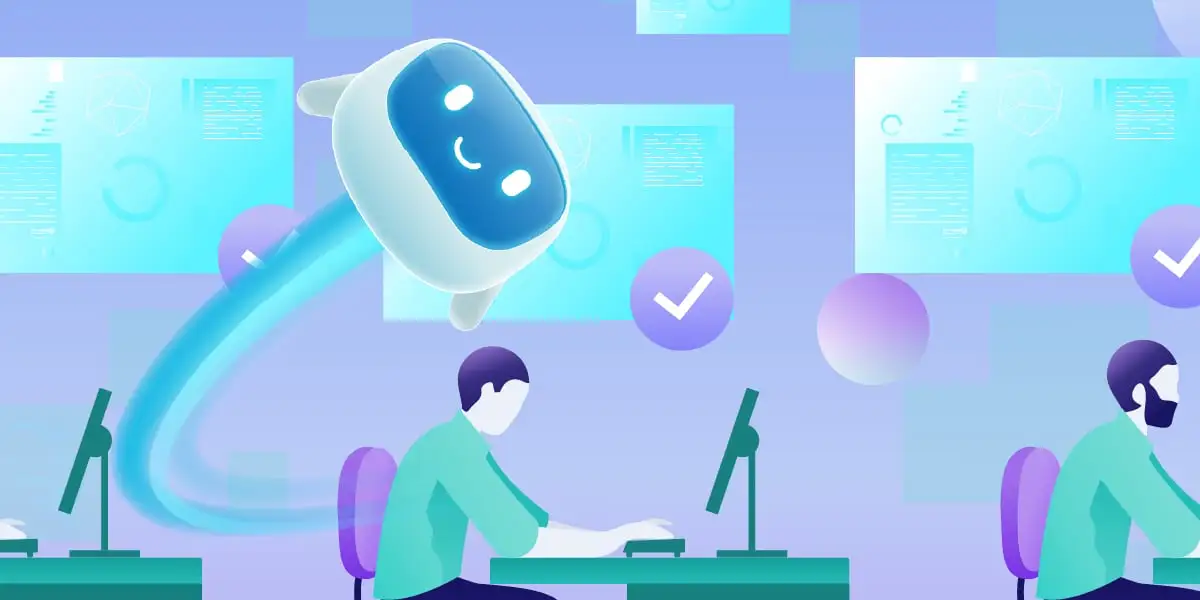
When it comes to technology, maturity means modernization with discipline. The goal is to build a stack that is more connected, scalable, and easier to use—rather than simply adding more tools. Of course, IT leaders must ensure their modernization efforts align with business goals.
Look beyond SaaS to AI agents
Mature digital workplace teams are modernizing endpoint management, Desktop as a Service, remote support, and experience monitoring as part of a continued shift to SaaS. This has historically created more agility, better scalability, and faster innovation cycles—and should continue.
At the same time, AI agents are likely to disrupt the user interfaces of major SaaS apps and allow for greater orchestration. While full disruption is unlikely due to deeply embedded infrastructure with highly proprietary data, digital workplace leaders need to start experimenting with AI agents.
Consolidate where it makes sense
Okta’s 2025 Businesses at Work report found that security tools account for 40% of the fastest-growing apps, while the global average number of apps per customer has now passed 100. In this context, it makes sense to counteract tool sprawl and seek out unified solutions.
Use AI to strengthen operations
AI also has a role to play, but only for practical use cases that accelerate maturity. It can speed troubleshooting, support automated remediation, and improve anomaly detection today. The point is not to layer AI onto fragmentation, but to use it in ways that compound the data in your environment. As we move into the future, AI agents will become more autonomous through increased repetition, understanding, and learning, and pave the way for the autonomous digital workplace.
Integrate instead of replacing
And finally, mature technology strategies avoid rip-and-replace thinking. Instead, they integrate with existing ITSM, security, endpoint management, and collaboration tools to create a more coherent ecosystem over time. That is what technology maturity looks like in practice: not more complexity, but more coherence. AI agents will also ease orchestration challenges across these complex landscapes.
A mature stack should make the digital workplace easier to manage and easier to use.
How TeamViewer ONE enables digital workplace maturity
TeamViewer ONE helps bring maturity into practice across people, process, and technology. It reduces silos by giving teams shared visibility and a more unified view of the digital workplace. That matters because maturity depends on ownership, not just oversight.
It also supports the shift from reactive support to proactive and predictive operations. With automation and AI embedded into workflows, teams can resolve issues faster, prevent more friction before impact, and make better decisions based on a connected view of the environment.
And at the platform level, TeamViewer ONE brings together remote connectivity, DEX, AI-powered insights, and endpoint management in a SaaS-native, platform-based architecture.
Across it all, the goal is to create a more connected foundation for a digital workplace that is intentional, experience-driven, and built to improve over time. This will lay the groundwork for truly autonomous digital workplaces, starting with autonomous endpoint management (AEM).
Conclusion: Maturity is a capability you build over time
If you take one message from this article, it’s that digital workplace maturity is a capability, and it happens over time.
Crucially, organizations that invest in strengthening this capability can innovate faster, retain talent, operate more securely, and drive measurable business outcomes.
And this happens, in effect, by focusing on employee experience and—by making smarter technology decisions—supporting all of us to do our best work.
The digital workplace may now be the norm, but maturity is what turns it into a source of resilience, performance, and business value.